
Michele Friedner
“No individual can arrive even at the threshold of his potentialities without a culture in which he participates” Ruth Benedict, Patterns of Culture (1934), quoted in Taussig et al. (2013)
Raj is a special educator who works with children between the ages of approximately nine to sixteen in the Giraffe Classroom at the Latika Foundation in Dehra Dun, India. Latika provides education, physical and occupational therapy, family support services, and vocational training, among other things to children with intellectual disabilities and their families. One afternoon during the summer of 2024, I sat with Raj while he took advantage of the quiet at the end of the day to engage in what he referred to as “documentation work,” documenting student progress toward their social and educational goals. In his small alcove of a classroom, we talked about some of his students, whom I had met on previous visits. Raj told me about positive changes he was observing. Ayush, who I knew as quiet and uninterested in his classmates, had made a “good friend” with another student in the class, Prakash. When Prakash wasn’t at school, Ayush asked where he was. When Prakash came back after an absence, Ayush told him, newly, that he was happy to see him. Ayush even shared his food with Prakash during tiffin time, a noteworthy change, because previously, he had not shared his food with anyone.
Raj was committed to tracking positive changes like these; they were evidence of his students’ kshamta, a Hindi term that translates as capacity. According to Raj: “Every child has their own pace of development and we need to see every child’s potential and then take them on a journey to meet their maximum potential.” When I asked Raj what he meant, he told me that every child with whom he works is “smart” and “capable” and they each have something (more) that they can achieve. According to Raj, it is special educators’ jobs to facilitate this something (more) through providing exposure and opportunities.
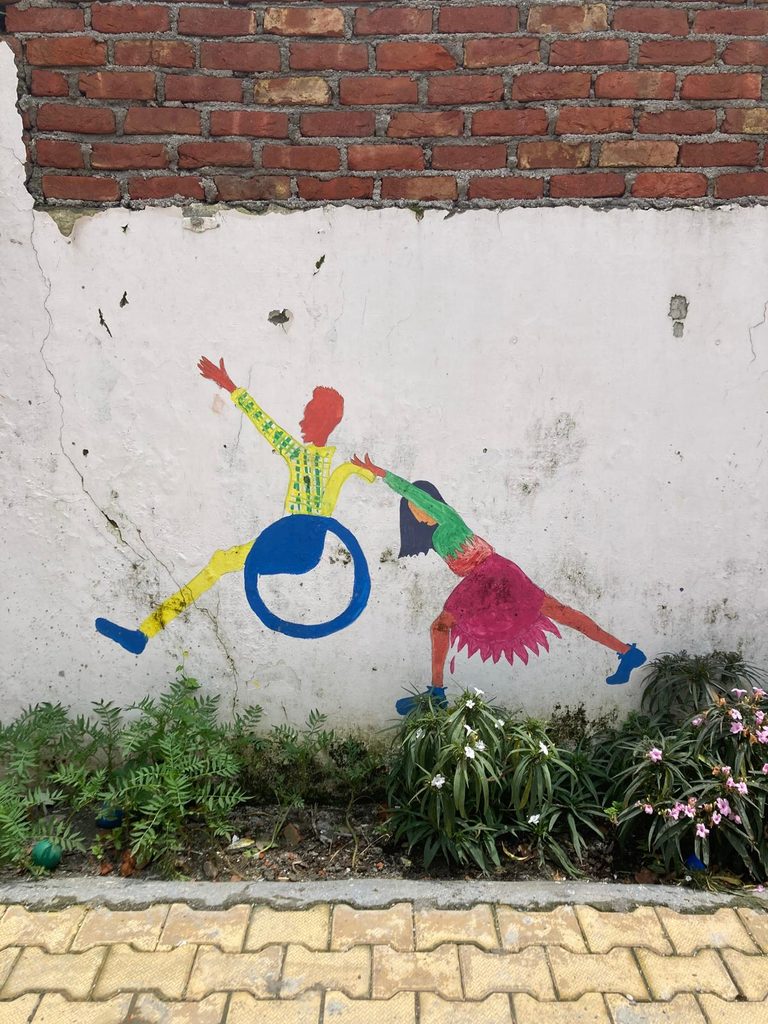
A mural on the wall of the Latika Foundation. The mural features a brightly clothed girl pushing a brightly clothed boy in a wheelchair forward and upwards. The boy has his arms stretched outwards and the duo appear to be working together to move. Photo taken by Michele Friedner.
In this essay I take inspiration from Raj’s steadfast insistence to me that all his students have kshamta to introduce a theory of “disabled potential” which engages and builds upon philosophical, educational, anthropological, and lay views of potential. I find the tension of placing “disabled” and “potential” together productive in challenging us to imagine potential otherwise. By otherwise, I mean that out in the world, beyond the gates of the Latika Foundation, people do not see Raj’s students as having potential. Indeed, intellectually disabled children and adults in India and internationally often experience routine dismissal of their capacities; they are seen in terms of what they cannot do and what they are presumed never able to do, such as marry, have employment, and/or be independent, among other things. By otherwise, I also draw from Emily Yates-Doerr et al. who stress the importance of “a commitment to amplifying practices that are vital and vibrant but which lack the recognition and power of dominant institutions.”
Elsewhere, I have critiqued the concept of potential as resulting in the evacuation of the present, as being focused on normative framings of success, and as ultimately devaluing and dismissing the possibility of diverse ways of being now and in the future. In addition, potential is often weaponized, as we see in the case of ubiquitous pop lessons in child development: “If you do not do X, your child will not achieve their potential.” Such statements send families into a panic and cause them to worry that the child they have is not or will not be an optimized or maximized child. The concept of potential as normatively understood can be thought of as potentialism, in that there is a narrow and fixed view of what someone is supposed to be and become and if people do not fit that mold, they are seen as not “living up to their potential.” Karen Sue Taussig et al. note that “[i]n biomedical practices, potentiality indexes a gap between what might, could, or even should be.” “Should” is key here, although all three—might, could, should—are overdetermined by ableist failures of imagination. These failures of imagination prevent us from seeing Raj’s students—and others—as possessing capabilities and potential.
Indeed, Raj and other special educators have shown me how potential can be open-ended, relational, and include both current and future capabilities. I contend that the concept (and framework) of disabled potential includes the following:
- It is open to relational, interdependent, distributed, and malleable understandings of change over time.
- It includes the possibility of staying the same, changing imperceptibly or slightly, and becoming something that is not socially legible or normative.
- It also considers potential beyond the individual and within an ecology of human and non-human actors; we might think more about a field of potential.
This is just the beginning of my list.
I saw disabled potential in action in the Giraffe classroom: through watering plants together, collectively washing and drying lunch plates, walking as a class to a nearby shop to chat with the shopkeeper, and playing ball games, and more. All are done collectively, with other students, with Raj and other teachers, and in the context of a broader world of families and beyond that, the city of Dehra Dun. Parents and extended family regularly come to the Latika Foundation to chat with teachers and other parents, observe students, and engage in activities. Students sometimes return home exactly as they left in the morning and sometimes they return with new repertoires such as the ability to share food, clean tables, and say hello and goodbye. And the broader community learns about Latika Foundation and the presence of disability through its mixed ability programming and mainstreaming efforts. Through these experiences and interactions, students meet “their maximum potential,” in Raj’s words. They do so socially and in connection with each other and the broader world. The “more” is relational, distributed, and subtle. It is not “maximum” in a maximalist sense but rather involves slow growth and subtle transformation.
What does this discussion of disabled potential have to do with anthropology? Anthropologists, particularly medical anthropologists, have critiqued the mobilization of the concept of potential, particularly in the context of childhood development and biomedical and technological interventions. For example, Michelle Pentecost has looked at early life interventions designed to maximize potential in children’s first one thousand days of life in South Africa and Eliza Williamson has explored the work of mothers in Brazil to capacitate children with significant disabilities caused by Zika. Anthropologists are in a key position to theorize disabled potentials because of their attention to everyday practices and meaning making, particularly under conditions of structural violence and constraint.
Indeed, anthropologists have provided rich examples of the disabled potential of thinking personhood otherwise, specifically through their analysis of non-normative communication and movement. A few examples: Tyler Zoanni writes about “failed people” with intellectual and other disabilities in Uganda who nevertheless make impressions on people and have distinct signatures; we can think of the productive possibilities of failure. As Zoanni notes: “There is no failure per se, only failure in relation to established expectations. Moreover, while in Uganda as elsewhere failure is narrated in negative terms, as loss or diminishment of collective and personal possibilities, failure can be productive.” Zoanni poignantly analyzes relationships between intellectually disabled people and non-disabled people and the ways that non-disabled people discern those with non-normative personhood. In a forthcoming article, Danilyn Rutherford writes of discerning interactional personhood in her movements through daily life with her intellectually disabled daughter: she and her daughter respond to each other, and she calls this proprioceptive agency. In her words: “You know animals have agency because they are responsive to their environment. Their behavior isn’t automatic, it’s emergent: animals move because they are being moved by what they feel. For people like my daughter, this point is particularly important. If it’s not our brains that make humans special, then it’s our bonds with one another.” It is these “bonds with one another” that produce conditions for both actualizing and discerning disabled potential.
I share another observation of Raj’s work with his students at the Latika Foundation, this observation more explicitly focused on the social work of potentializing people. One day in Summer 2024, the year before the conversation with Raj with which I opened this essay, I observed a student in the Giraffe Classroom having an outburst. The student, a teenager, was sitting outside his classroom in the school’s common area wiping down metal plates from lunch, which had just been washed by other students in the class. He suddenly threw two of them to the ground with a large bang. In response, a new aide came over to attend to the student. The aide, to calm the student down, awkwardly led him back into the classroom to sit at a table facing a wall. Raj looked at the student, who was rocking in displeasure, and then went out into the hall to see what happened. He quickly asked the aide to bring out a floor mat into the common area and then he guided the student back into the area. He sat down with his student and adjusted him, so they were sitting cross legged facing each other with their knees touching, and he helped him to wipe the plates. He handed the student a towel and at times he also took the student’s hands to wipe the plates for and with him (although for and with are not necessarily meaningful distinctions). After the plates were dry, Raj raised a basket in which he wanted the student to put the plates. The student constantly grabbed Raj’s face and Raj calmly redirected him. At the end of the activity, the plates were clean and Raj gave his student a hi-five. The student could ostensibly feel proud of his work. He was also calmer. He and Raj had worked together and achieved something; they had jointly completely a task that was helpful to everyone else in the Giraffe Classroom. This is social potential actualized in the moment.
The need for a more inclusive and capacious understanding of potential is urgent because we are increasingly living in times of mass disablement caused by genocide and war, deferred or stalled futures resulting from precarity, and environmental catastrophes because of climate change. How do we avoid ending at accounts of structural violence? As the disability studies scholar and activist Akemi Nishida asked me during a personal conversation, and I paraphrase: who has the privilege to achieve normative potential? We need a framing of potential that recognizes what people are right now to, with, and for each other to avoid framings that are solely about lack and deficit. As Kelly Fritsch and Anne McGuire argue, we live in a “broken world” in which brokenness is by design. I agree with them about structures and institutions being broken and I think we need ways of not seeing people as broken.
Returning to Benedict’s quote that I opened this essay with, I see the social work of Latika Foundation as prefiguring a culture, or social world, in which potential is understood otherwise. I want more anthropologists and people in the world in general to adopt this understanding.
Author Bio
Michele Friedner is a medical anthropologist and professor in the Department of Comparative Human Development at the University of Chicago. She is the author most recently of Sensory Futures: Deafness and Cochlear Implant Infrastructures in India (2022, Minnesota UP) and the forthcoming We Can’t Wait: Disability Practices Now (2027, Minnesota UP). We Can’t Wait also features the magic of the Latika Foundation. Michele would like to thank Jean Hunleth for her amazing editorial work, Christine Sargent, Eliza Williamson, and Mara Green for their reads, and of course, Raj for all his incredible work.