
Katharina Rynkiewich, Melina Sherman
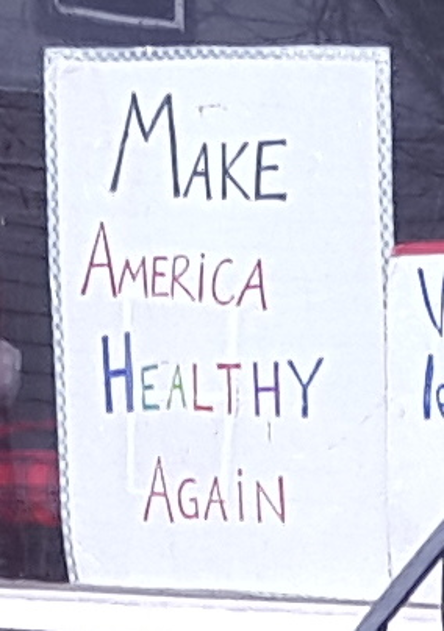
Protest sign, “Make America Healthy Again,” January 2017, Portland, Oregon.
Photo credit: Walklandia from Portland, Wikimedia Commons: https://commons.wikimedia.org/wiki/File:Make_America_Healthy_Again.jpg

As two medical anthropologists who teach and write about infectious disease, chronic illness, public health, and the politics of care in the United States, the past year has made newly visible what anthropology has long shown: health is never only biological. It is also political, moral, institutional, historical, and unevenly distributed.
This edited series, “The Stakes of Making America ‘Healthy’ Again,” examines the emerging public health formation gathered under the banner of Make America Healthy Again, or MAHA. We take MAHA not only as a slogan or policy agenda, but as a shifting political-cultural project: one that names a real and widely felt crisis of chronic illness, medical mistrust, food insecurity, pharmaceutical power, and institutional failure, while also reframing that crisis through a contested language of “root causes,” personal responsibility, medical freedom, institutional suspicion, and national renewal. Official MAHA materials describe the initiative as an effort to reform America’s “food, health, and scientific systems” to identify the “root causes” of chronic disease; in public communications the White House has similarly framed MAHA around chronic disease, nutrition, preventive care, and health-system accountability.
In Florida, where both of us have either lived or currently live, Surgeon General Joseph Ladapo made headlines when he announced an end to vaccine mandates for children in the state, saying “Who am I to tell you what your child should put in your body?” Then, the states of Washington, Oregon, and California formed the “West Coast Health Alliance,” aiming to provide recommendations on immunization with the understanding that national recommendations may no longer be reliable or science based. Meanwhile, pockets of measles infection turn into a multi-state outbreak, with conditions increasingly favorable to disease spread. Unfortunately, the turn away from science has also meant a turn away from necessary medical treatment. In 2024, unassisted home births rose, as did complications during delivery that went unnoticed in that setting. In 2025, announcements signaling intent to revise the childhood vaccine schedule were rampant.
For medical anthropologists, this shifting political-cultural project is an especially urgent object of analysis. MAHA’s appeal cannot be dismissed as simply anti-science, nor can its consequences be understood only through the language of misinformation. MAHA draws power from real failures: the failures of biomedicine to care well for chronically ill people; the failures of public health institutions to maintain trust; the failures of food, labor, housing, and environmental systems to support collective well-being; and the failures of the state to protect people from preventable harm. At the same time, MAHA often redirects these failures into selective forms of suspicion, intervention, and abandonment. It can challenge “Big Pharma” while leaving other structures of profit intact; celebrate bodily autonomy while supporting intensified surveillance or coercion for some populations; invoke prevention while undermining vaccination, harm reduction, reproductive autonomy, and public health infrastructure; and call for national health while narrowing who is imagined as deserving care.
The COVID-19 pandemic shows how MAHA is not simply a product of the current administration, but instead represents a culmination of processes that were already underway in American politics and public health. The United States possessed extraordinary biomedical capacity, including the rapid development of COVID-19 vaccines, yet it also became a site of widespread resistance to recognizing COVID-19 as an ongoing collective threat. In the pandemic’s aftermath, public health authority has become increasingly fragmented, vaccine policy increasingly politicized, and the meaning of “health” increasingly unstable. Recent debates over vaccine mandates, regional public health alliances, measles outbreaks, unassisted birth, childhood vaccine schedules, reproductive restrictions, drug criminalization, and Long COVID all point to a broader transformation: health is being reorganized through struggles over expertise, freedom, responsibility, risk, and the role of the state.
This series asks: What becomes possible, and what becomes dangerous, when “making America healthy” becomes a governing project? What kinds of suffering are recognized as signs of national decline, and which are minimized, moralized, or ignored? Who is asked to take responsibility for health, and who is denied the material conditions necessary to be healthy? Which institutions are treated as corrupt, which forms of expertise are elevated, and which populations are exposed to abandonment, coercion, or blame?
At a moment when the discipline of anthropology is being publicly challenged for taking seriously questions of power, inequality, and political obligation, the stakes of this kind of inquiry are particularly clear. Medical anthropology has long argued that power, politics, health, and illness are deeply interconnected, and that health outcomes cannot be explained by biology alone. Health and illness must be studied in conjunction with the particular institutions, histories, markets, and political decision-making processes that materially enter into human bodies. As medical anthropologists, we study these different forces together, moving between policy and everyday life, scientific knowledge and lived experience, institutional systems and the bodies they act upon. This makes the medical anthropologists writing in this series well-equipped to analyze a formation like MAHA, whose force lies precisely in its ability to join legitimate experiences of illness and institutional failure to contested claims about causation, expertise, freedom, and responsibility.
The pieces in this collection approach the stakes of MAHA from different ethnographic, historical, and political locations. Together, they examine MAHA as a formation that links infectious disease policy, chronic illness, reproductive health, neurodivergence, harm reduction, digital influence, clinical labor, and the politics of expertise. The contributors bring grounded expertise across the diverse themes inherent in medical anthropology and public health, including infectious diseases, reproductive politics, disability, neurodivergence, substance use, digital culture, and chronic illness. Kristin Hedges examines the tension between the medical freedom movement and the intensified medicalization and governmental oversight of neurodivergent people, particularly autistic people. Bethany Jowers analyzes reproductive health and harm in Florida, where restrictions on abortion and attacks on intellectual freedom intersect in the lives and labor of reproductive health professionals. Shana Harris considers how MAHA values intersect with law-and-order and other tactics to police people who use drugs by giving governing strategies a health vocabulary. Melina Sherman examines MAHA’s relationship to chronic disease politics, showing how MAHA recognized Long COVID while detaching it from the public health emergency that produced it and withdrawing crucial infrastructures of prevention, funding, and responsibility. Martha Lincoln analyzes the digital cultures, influencer practices, and online aesthetics through which MAHA circulates and coheres despite its ideological instability.
Taken together, these essays treat MAHA as a diagnostic site: a way to understand how American health politics are being remade after COVID, after Roe v. Wade, amid rising chronic illness, and in the context of deepening distrust in public institutions. The series does not presume that MAHA is one thing, nor that all its concerns are illegitimate. Rather, it asks what kinds of political work MAHA performs: what it reveals, what it obscures, what it mobilizes, and what forms of care, coercion, refusal, and abandonment it may help make possible.
It is a disconcerting time, both for social scientists who have been studying American healthcare for years and for citizens who have borne the brunt of massive sociopolitical changes to what it means to be healthy in the United States. But we do not have to document it alone, think through it alone, or do scholarship alone. This series challenges its readers to examine the making of “health” as a political project—and to ask, urgently and collectively, what is at stake in the promise to make America healthy again?
Katharina Rynkiewich is a medical anthropologist at Washington State University who does work on infectious diseases and infection control, particularly on the topic of global antimicrobial resistance and antibiotic decision-making.
Melina Sherman is a medical anthropologist at the University of Central Florida whose research examines how public institutions respond to health crises and what happens when emergency measures are withdrawn. Her current project investigates the governance of chronic illness in the United States after the COVID-19 pandemic.