
Bethany Jowers
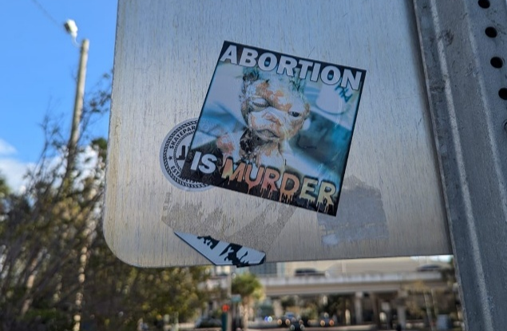
Abortion is Murder sticker on the back of a street sign in Florida. Photo taken by author near field site.
In 2022, the U.S. Supreme Court released its decision on the case Dobbs v. Jackson Women’s Health Organization, undoing nearly 50 years of federal protection over abortion in the United States. Rather than guaranteeing all citizens the right to abortion as a private, health-related matter, the federal government now leaves abortion legality in the hands of the 50 individual states. In the four years since Dobbs, many states have strengthened their protections over abortion, but some have installed partial or total abortion bans. In my home state of Florida, abortion has been made illegal after six weeks of gestation, a date which precedes most people’s first prenatal appointment.
The timing of Florida’s abortion bans coincided with my entry into anthropological training, and = impacts of these bans refocused my research interests from distant countries toward my own. During my M.A. thesis research at the University of South Florida, I explored what it was like to work in the field of reproductive health in the “post-Roe” era. I spent months traveling across different reproductive health care spaces, passing palms and kudzu-covered pines along the interstates and stepping into the cool, sterile interiors of offices and clinics. As part of this research, I met Eleanor.
Eleanor is an OB/GYN resident physician in Florida. She was born and raised in the state, like me. By sharing with me her experiences as a reproductive health caregiver, she helped me to understand the nuanced human experiences of abortion bans, which do not align with the state-espoused rationale for their installment.
Florida governor Ron DeSantis has praised the abortion bans he signed as an end to the epidemic of “broken families,” aligning himself and the state government under a long tradition of reproductive governance which would enforce the health of the American body politic by making it impossible for pregnant people to obtain abortions. These laws are framed as medico-moral cure; they are purported to decrease fetal and infant mortality, eliminate irresponsible parenthood, and bolster the wellbeing of American society by upholding its most fundamental element: the nuclear family.
The Florida state government’s position claims pro-life and pro-natalist motivations, enforcing abstract fantasies of national health, family integrity, and moral order at the individual level. It is aligned with the larger MAHA movement in this way; both adopt the youngest generation of Americans as their object of defense, intervening to shield the future of our country from the selfish decisions of adults present. To make America healthy again — to mend the “broken families” of Florida — a governing project must control and curtail these decisions as they happen.
But Eleanor helped me to see what is unrecognizable from the vantage point of this governing project: abortion bans do not relieve societal suffering but merely reorganize it along new human axes. The effect of these laws on the ground is not an elimination but an arbitration of harm — a redistribution of fear, pain, blame, and death among all those involved in reproductive health and care. This includes pregnant people, their families, and their providers.
Ethnographic Insights from Eleanor
These effects are felt most keenly in the reproductive health care setting, where abortion bans render compassionate, essential interventions illegal. Eleanor told me a story of one such instance, which I present below as a poem derived from her interview transcript.
I had a patient who came in with her water broken very early. She was twenty weeks or so. She was under viability. If she had delivered the baby, they wouldn’t resuscitate it because she was too early.
But because her water broke, she was susceptible to all sorts of infections because she wasn’t delivering.
She was just sitting there with no water.
And I just watched her for multiple days. I was a student at the time, doing an away rotation, so I was just watching from the sides, watching her vitals, seeing how she was feeling.
She started to show signs of infection.
She started to bleed
a lot.
And we were like, this situation needs to be resolved, and the only way to do it is to induce her labor, because her uterus is not recognizing that she needs to have this baby.
But because of the abortion laws, we couldn’t induce her labor unless she was actively dying.
And she wasn’t at the time.
So we just had to watch her
go
into
septic
shock
before we could do anything.
And it was just so frustrating because we knew what was coming.
We knew she was going to go into septic shock.
And so it was just like, how many days are we going to sit and wait here for her to go into septic shock before we can actually do anything?
The cord ended up falling out, too.
So then the baby’s heart rate was tanking
and we just couldn’t do anything.
And it was so frustrating because we’re called into medicine because we want to help people.
And we have this Hippocratic oath of, “Do no harm.”
And I couldn’t look at that situation and feel like no harm was being done.
In another story, Eleanor was taking care of a patient who was roughly five weeks pregnant. The patient had recently received abnormal results from a routine mammogram and was awaiting further results from a breast biopsy. If the biopsy was cancerous, she would have to terminate her pregnancy to begin cancer treatment. If the biopsy was not cancerous, she wanted to keep the pregnancy and welcome her new baby. But because of Florida’s six-week abortion ban, the patient decided to terminate her pregnancy before receiving the biopsy results, fearing that after six weeks of pregnancy she would be unable to receive abortion care and thus unable to start life-saving cancer treatment.
These two events Eleanor described to me differ in terms of their clinical management: one is characterized by urgent action unduly suppressed, the other by a momentous decision unduly hastened. Although Eleanor did not share these details with me, one can also imagine the experiences of kin who accompanied these patients — the worry and grief they must have borne alongside their pregnant partners, children, siblings, or friends. Uniting these different stories is the reason they both came to pass: post-Dobbs abortion bans. Even Florida’s bans — which are only “partial” and include exception criteria — engender these dangerous and tragic situations by flattening the complexities of reproductive health under political rhetoric. As Eleanor’s stories help us to understand, the actual human endpoints of these bans are agonizing health decisions which she and her colleagues are both forced into and forced to witness as part of their daily practice in Florida.
Digital Surveillance and Transparency
Another influence over reproductive health care in Florida is the broad transparency legislation of the state. Under both the 20th-century Florida Sunshine Laws and the increasingly rigorous health outcome reporting standards built into abortion bans, Eleanor’s every move as a care provider —faithfully documented in the electronic medical record — is subject to scrutiny by a panoply of actors real and imagined, corporeal and digital.
Eleanor expressed feeling afraid of surveillance from her own patients.
Every time some patient would do something slightly off, like take a picture of our consent form or ask an odd question, it always would set off an alarm in my head and my attending’s head of like, is this person a plant? My attending constantly was worried about, like, is this person a plant?
She described a situation in which she was counseling a pregnant patient whose first language was Haitian Creole, and the patient wanted to take a recording of their interaction to translate later at home. Eleanor did not allow her to record the interaction because she was afraid of the legal repercussions she might incur for offering appropriate medical counsel — such is the extent of the “chilling effect” of abortion bans, as my interlocutors described it to me. Eleanor later regretted that choice, though it might have protected her, because she knew it left her patient with a less clear understanding of her own prenatal care.
These negative emotions — fear, distrust, frustration, and eventually, burnout — constitute an additional layer of stress in the OB/GYN workplace, which is already characterized by extreme, unsustainable labor demands. As a resident physician, Eleanor’s work schedule is structured under a system which requires 60-80 hours of patient care work per week for a median annual salary of $42,470 USD in Florida, or roughly $11.00 per hour.
Although this exploitative system certainly challenges those who work within it, Eleanor identified the erosion of trust between her and her patients as being more difficult to overcome.
Everyone always told me like, oh, residency is going to be really hard because you’re working a lot of hours. You’re going to be tired, physically tired. I don’t even feel physically tired. I feel like this is very similar to, like I played college sports, I went to med school, I’m used to pushing through physical fatigue. But it’s more of the emotional toll of, like, no one trusts you. Everyone thinks you’re trying to hurt them. People think you’re the bad guy.
I made the painting below inspired by Eleanor’s stories and quotes from online community members. The art was a way to both illustrate and emotionally vent the embodiment, the violation, and the felt effects of being caught in our home state’s arbitration of harm.
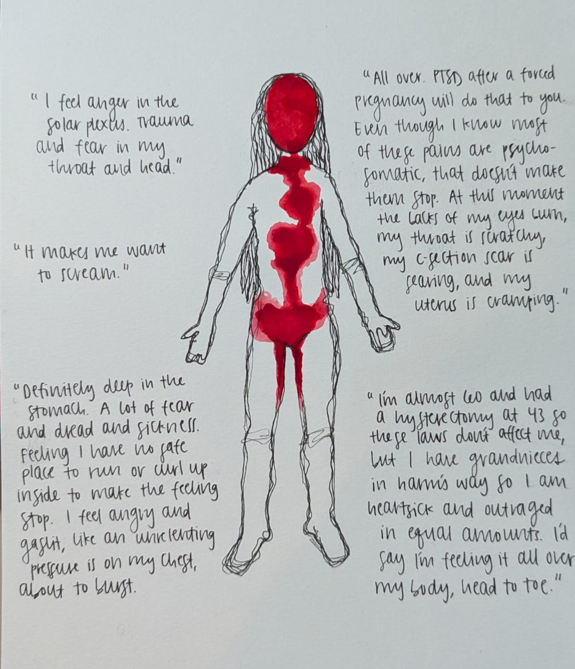
Where do you feel it when the government violates you? A map of reproductive harm. Art piece created by author.
“We all live in Florida.”
Eleanor was only one of fifteen reproductive health professionals I spoke with during my thesis research. Many of them told me the harms they face under abortion bans are enough to make them reconsider their involvement in the field, especially in ban states like Florida. Indeed, Florida is one of many states which has sustained a slow but not unfelt depletion of OB/GYNs since its trigger bans went into effect after Dobbs. Everyone I encountered at my field sites either knew, or knew of, a reproductive health colleague who had left Florida to practice elsewhere. One community health worker told me, “We are hemorrhaging providers.”
It bears recognition that these bans and their effects, while intensely publicized in Florida due to our aforementioned transparency laws, are in no way confined to the state. Florida is only one of 12 U.S. states considered “hostile” to abortion; 13 others currently have more restrictive or total bans. As medical anthropologist Risa Cromer said during the 2024 meeting of the American Anthropological Association held in Tampa, “We all live in Florida.”
But amidst the growing dearth of reproductive health care professionals in ban states, Eleanor has chosen to stay. Florida is her home, like it is mine. She explained:
In red states, people still need care, especially from providers who are going to advocate for them. And so if we have this mass exodus of people out of red states, who’s going to be left in red states is people who don’t support this access. And then the problem is just going to keep getting worse. I’m still here because I think there’s a lot of work to be done here in Florida specifically. And it’s really hard work, and maybe it would be easier elsewhere, but that’s not a reason to go elsewhere.
During our ethnographic relationship, Eleanor brought me closer to the complexities of reproductive health care decisions, which defy anticipation or understanding from any degree of distance. Given these complexities, the political intrusion of abortion bans upon the clinical space results not in the elimination of harm, but only its arbitration. Rather than assuaging the societal suffering of the American body politic, abortion bans only redistribute pain, blame, fear, and death among the individual patients, providers, and kin involved in reproductive health.
So, perhaps the oath Eleanor took as a medical provider — first, do no harm — was imperfect, or at least incomplete. Perhaps it is no longer possible to do no harm, no matter which state we come from or work within. Eleanor’s experiences illuminate the need for strengthening both the professional ethic of reproductive medicine as well as the powerful cultural systems which should protect it. One such system is of course the Florida state government, but another is the informed and empathetic American public, of which anthropologists are a part. Now, as carriers of Eleanor’s lived experiences, we are all called toward a reimagination of agency in reproductive health care, which starts with restoring trust and privacy to the humans who are directly involved.
Author Bio
Bethany Jowers earned their M.A. in Applied Anthropology from the University of South Florida. They are currently based far from home in Boston, Massachusetts, studying as an MD-PhD student at Harvard Medical School and MIT HASTS.