
Shana Harris
University of Central Florida
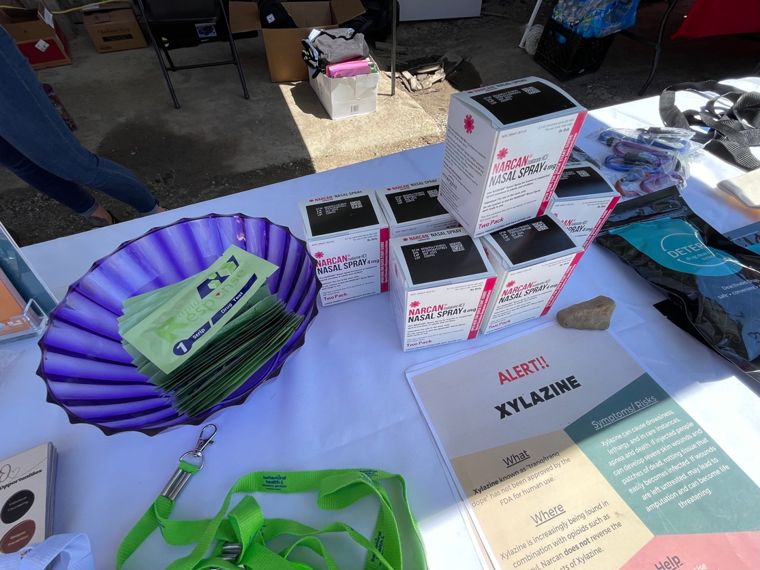
Harm reduction materials, Photo credit: Creative Commons
Since the beginning of Donald Trump’s second presidency in January 2025, there has been a noticeable shift in how drug use and addiction are governed in the United States. Various executive directives and initiatives have set forth federal priorities and strategies to address these topics, many of which align with or are directly informed by the Make America Healthy Again (MAHA) movement and its principal architect, Robert F. Kennedy, Jr.
In this essay, I engage in an anthropological inquiry of current U.S. federal policy and funding schemes to discuss the management of drug use and addiction in the MAHA era. I show how the MAHA agenda intersects with law-and-order and moralistic tactics that police populations deemed problematic to public safety, public order, and even themselves by giving such strategies a health vocabulary. In so doing, MAHA makes health conditional on adherence to particular forms of intervention and governance. My analysis of this development speaks directly to a core project of medical anthropology—to show how health is never a neutral, biological state but a site of political struggle over who counts as a legitimate subject of care. It draws on anthropological research to interrogate the ways in which MAHA’s methods and values exacerbate the very issues around drug use and addiction that the government is aiming to fix.
In July 2025, just six months into his second presidential term, Donald Trump signed Executive Order 14321, Ending Crime and Disorder on America’s Streets, which introduced the new federal government’s law-and-order approach to drug use, mental health disability, and homelessness. While the executive order does not create legislation, it does many other things.
The order identifies specific populations – people who use drugs, people living with mental health disability, and people who are unhoused – as menaces to public order. It asserts that past administrations failed to address the “root causes” of homelessness, which they claim have left “other citizens vulnerable to public safety threats” posed by these groups. Despite the fact that most people who are unhoused are not using drugs regularly, the order draws a strong connection between drug use and homelessness. Even before taking office the second time, Trump spoke of the two together when calling on states to ban urban camping: “The homeless have no right to turn every park and sidewalk into a place for them to squat and do drugs.” The association plays on fears that people who are unhoused and use drugs publicly endanger public safety, a concern that has long fueled vagrancy laws across the country that made it “a crime to be poor, idle, dissolute, immoral, drunk, lewd, or suspicious” and “targeted objectionable ‘out of place’ people.” Such fear gives credence to the order’s push for increased policing and surveilling of unwelcome and assumedly unsafe individuals.
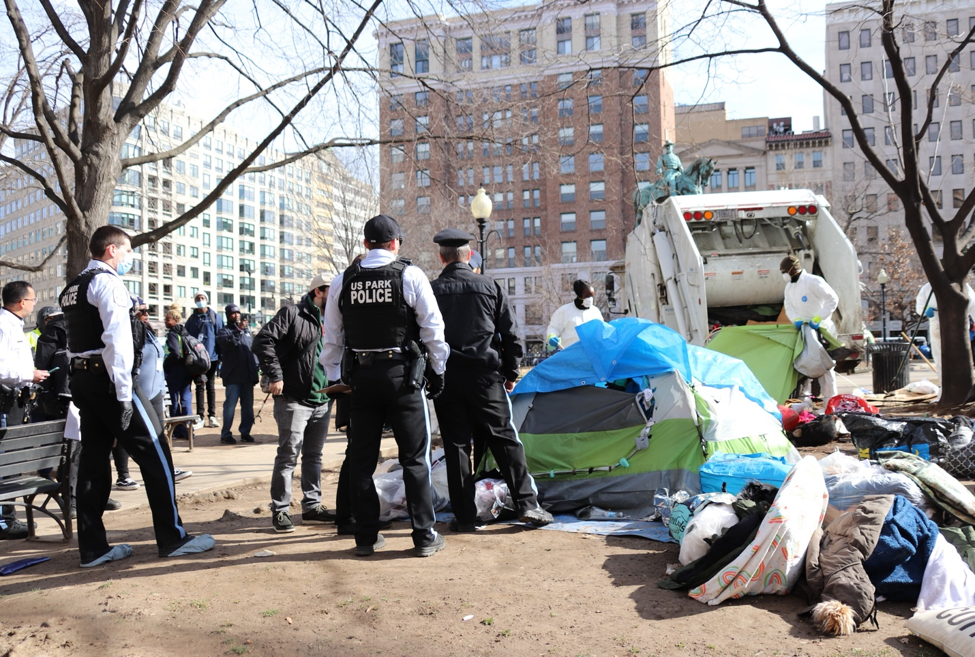
Eviction of an unhoused encampment, Photo credit: Creative Commons
In addition to allocating funds to law enforcement for “encampment removal efforts,” the executive order calls for a more aggressive and punitive approach to homelessness to “restore public order”—civil commitment. As the order explains, individuals who are unhoused, including people who use drugs and people living with mental illness disability, will be moved into “long-term institutional settings for humane treatment through the appropriate use of civil commitment.” Sometimes referred to as involuntary or coerced institutionalization, civil commitment is the legal process by which someone is forced into mental health or drug treatment at a hospital or other facility against their will. Civil commitment is nothing new in the U.S., and its local application has gained momentum in recent years.
The restoration of civil commitment as a public safety “solution” aligns with the order’s overall law-and-order focus. However, the disciplinary qualities of civil commitment are obscured by its framing as “humane” and “compassionate to the homeless.” Civil commitment is not about providing quality drug or mental health treatment to those that “cannot care for themselves” or for the sake of public safety. Rather, it is about exercising carceral power – in a Foucaultian sense – by connecting healthcare provision with the courts, law enforcement, and confinement through a language of care. As health scholars Rafik Wahbi and Leo Beletsky explain, “If the goals of the penal system are to punish through violence, then involuntary commitment’s goals will be relationally connected to commit such violence on people and bodies that are deemed deviant.” This is why Wahbi and Beletsky refer to civil commitment as a “carceral-health service.”
The tough love approach of civil commitment does not fit with the MAHA principle of medical freedom. MAHA advocates for the right of individuals and families to make their own healthcare choices free from government interference, most notably but not exclusively around childhood vaccines. It is about personal autonomy and self-determination. But civil commitment takes away that choice. It forces individuals into treatment; it is involuntary and coercive healthcare, a phenomenon that has drawn considerable scholarly attention and scrutiny. When it comes to treating addiction, research shows that there is insufficient evidence that compulsory drug treatment effectively reduces drug use. Some scholars suggest that it is unethical or can have adverse outcomes due in part to its carcerality. Therefore, if people who use drugs are not afforded the choice to enter into treatment on their own terms, it is clear that medical freedom under MAHA is selectively applied. My argument here aligns directly with medical anthropological research on “deservingness” that demonstrates how healthcare systems can sort people into moral categories of worthy and unworthy recipients of care, often with detrimental effects.
Executive Order 14321 further departs from established scientific guidance by restricting federal funding of interventions based on harm reduction, a service approach aimed at decreasing negative effects of drug use and addressing conditions of use. The order states that the Substance Abuse and Mental Health Services Administration (SAMHSA) must fund “evidence-based programs” for drug prevention, treatment, and recovery instead of programs that they claim “fail to achieve adequate outcomes, including so-called ‘harm reduction’ or ‘safe consumption’ efforts that only facilitate illegal drug use and its attendant harm.” With this new directive, SAMHSA will no longer fund certain harm reduction supplies and interventions, including syringes and needles, pipes and safer smoking kits, and test strips for drugs like fentanyl and xylazine.
The executive order asserts that harm reduction efforts wrongfully “facilitate” drug use; it “allows” drug use to continue unabated by not requiring abstinence as a condition of care. This claim of enablement is one of the oldest and most common leveled against harm reduction, one that past federal administrations also weaponized to prohibit funding for life-saving interventions, even though empirical evidence does not support the enablement narrative. Moreover, the executive order disavows harm reduction while at the same time calling for evidence-based interventions. Yet research consistently shows an evidence base for harm reduction interventions – from syringe service programs to supervised consumption sites to overdose medication distribution – that have contributed to multiple positive health outcomes, including but not limited to reductions in blood-borne infections and overdose morbidity and mortality. Additionally, the loss of federal support for policies like Housing First, which does not require abstinence or being in drug treatment as a precondition for housing but according to Executive Order 14321 “deprioritize accountability and fail to promote treatment, recovery, and self-sufficiency,” are life-threatening for people already living at the social and economic margins of U.S. society. By upholding a specific moral order in which personal responsibility and self-improvement are valorized above safety and survival, MAHA’s argument against harm reduction is a moral rather than scientific one.
In turn, the federal government is committed now to directing resources toward programs that promote lasting recovery in the form of abstinence. This approach is informed in part by Kennedy’s own recovery from heroin use, which he attributes largely to abstinence-based 12-step programs, and MAHA’s focus on chronic disease. To direct this effort, Trump launched the Great American Recovery Initiative with the signing of Executive Order 14379, Addressing Addiction Through the Great American Recovery Initiative, in January 2026. With Kennedy as its co-chair, the initiative has a stated focus on “long-term resilience” of people who “suffer from addiction.”
Executive Order 14379 explicitly references the brain disease model of addiction as its guiding paradigm, a contested model that posits addiction as a chronic, relapsing brain disorder caused by functional and structural brain alterations resulting from drug use. Its proponents assert that this form of medicalization helps reduce stigma of people who use drugs, although this claim has been critiqued. Importantly, it is a neoliberal paradigm focused on both individual biochemistry and personal responsibility for addiction management, leaving little room for considering social and structural factors that can contribute to or drive drug use in the first place. Attention to these factors have been central to critical medical anthropological analysis of drug use for decades, furthering underscoring the importance of challenging the kind of biomedical individualism shaping addiction care under MAHA.
To further stimulate this “Great American Recovery,” Kennedy announced a $100 million investment in a complementary venture called the Safety Through Recovery, Engagement and Evidence-Based Treatment and Supports (STREETS) Initiative. The initiative’s goals are “long-term recovery and independence” and “to support people in recovery to lead productive lives in their communities.” And the supposed correct way to long-term recovery, independence, and productive lives is through abstinence. This belief heavily influences MAHA’s critique of medications for opioid use disorder (MOUD). Such medications, which include methadone and buprenorphine, are evidence-based treatments that can effectively reduce opioid use and increase treatment retention and are associated with reduced overdose risk. Nevertheless, the federal government sees these approaches as either short-term fixes or discouraging recovery, despite research showing their effectiveness as conduits to drug treatment. This is also why SAMHSA will now conditionally fund MOUD only if provided alongside recovery support services like counseling. The decision reveals MAHA’s anti-medication bias: “medications are part of the pathway to long-term recovery and sobriety, self-sufficiency, and thriving, not as a default sentence to life-long medication use.” It upholds the belief that the individual should depend on themselves rather than this type of medical intervention for self-improvement. It also ignores the racialized and moralized histories of addiction science. Anthropologists and other social scientists have chronicled how social, political, and economic determinants of drug use were often sidelined or even erased in the development of MOUDs. The characteristics of an individual’s drug use – rather than the conditions of their use and lives – became the focus, an emphasis that has contributed to uneven access to these medications for different groups in the United States. This legacy likely will persist under MAHA’s purview if it does not recognize how its policies will impede the widespread and effective utilization of MOUDs. In light of such abstinence-based recovery politics, MOUD is tolerated only when folded into a pathway to sobriety and self-discipline rather than as ongoing care through medication maintenance. This again demonstrates how healthcare is politically entangled with moral ideas around deservingness under MAHA. People who use drugs become unworthy of unconditional care. Instead, they must prove their worthiness through abstinence and treatment compliance.
We are witnessing the rollback of evidence-based drug use and addiction interventions alongside the continued and escalating policing and moralizing of people who use drugs and adjacent, all in the name of public safety, public order, and the alleged concern for recovery. These efforts contain trademarks of the MAHA agenda, particularly neoliberalism, anti-science skepticism, and underlying causality. But MAHA’s reach is not limited to the policy and funding schema of Trump’s second administration; it is already influencing the creation of punitive and unsafe drug use-related federal, state, and municipal legislation and policies.
Even more gravely, these tactics will cost lives. After reaching an all-time high in 2023, the U.S. is seeing a steady decline in overdose deaths for the first time in decades, due in part to the availability of overdose medications and other harm reduction interventions. But overdose rates are still alarmingly high, and limiting access to supplies and services like test strips and MOUD that can reduce fatal overdose risk will likely increase mortality. As MAHA creeps into the governance of different facets of national and local politics, healthcare, and life itself, we as anthropologists must question for whom MAHA is making America healthy again. Health choices and lack of state interference in those choices are framed as “freedom” for the abstinent, the housed, and the orderly. But for people who use drugs, the unstably housed, and those marked as disorderly or incapable of making the “right” decisions, heightened surveillance, forced removal from public spaces, and behavior modification is demanded before care is offered. This demand puts the health and lives of countless people at risk and amplifies the already widespread moralization and criminalization of drug use and the people who engage in it that so many of our colleagues have already begun documenting.
Author Bio
Shana Harris is an Associate Professor in the Department of Anthropology, with a secondary joint appointment in the Department of Internal Medicine, at the University of Central Florida. Her research focuses on drug use, “addiction,” and the politics of intervention in Latin America and the United States. Her current work examines psychedelic-based drug treatment in Mexico and harm reduction policy and practices in the United States.