
Silvana Matassini Eyzaquirre
During my doctoral research in Hull, UK, I explored loneliness and resilience among older women. Along the way, I encountered the unfolding process of dementia in one of the women I came to know: Erin. As her dementia progressed, we spent time talking about her life, what she loved, her pleasures. We also imagined going on a swim, visiting Toronto, and listening to Sinatra. We developed a friendship.
To speak about dementia is often to speak about loss. A person may become socially diminished or less recognizable to others well before their life comes to an end. But beginning with the person, seeing a person, not only a patient or a diagnosis, offers a different way to connect, and perhaps of caring. It reminds us that care is not only about managing decline, but about remaining attentive to a life lived, and to a person who continues to exist beyond the erosion of memory. Care systems are frequently organised around deficits, what is lost, what no longer functions. But what if care were also oriented toward what remains?
In what follows, I attend to those fragments that made it possible for me to relate to Erin, how they were gathered and sustained, and what they opened up in our relationship, as well as in my understanding of Alzheimer’s and of caring for someone living with it. These fragments, those small pieces of memory, words, or gestures, are not secondary or merely residual; rather, they reveal something fundamental about the person, a mode of presence that persists and is reaffirmed through everyday interaction. Fragments should not be understood simply as traces of loss, but as moments through which relationships continue to be articulated and re-encountered, as it is within these fragments that the capacity to express presence, memory, and connection resides.
I came to know Erin through fragments: in the stories she told, the moments she lingered on, and the ways she expressed what mattered to her. These were not incomplete versions of a whole, but meaningful expressions of who she was. They made it possible to encounter her beyond her diagnosis, and to think of care in relation to the person as encountered, rather than solely in terms of a condition.
Our relationship was not built in spite of fragmentation, but through it. It was within these partial, shifting moments that connection became possible. I do not suggest that a shift in perspective alone can resolve the complexities of caring for someone with dementia. But perhaps, if we begin by attending to what remains, by valuing these fragments, we might begin to care differently, both for those living with dementia and for those who care for them.
On Being with Erin
Erin is 78 years old, one of her passions has been driving. She loved discovering new places; for many years, she, her husband, and their son took long road trips, with Erin as the main driver. She was a woman ahead of her time, proud of an autonomy she had built long before it became socially expected.
After her husband’s death, driving became her way of enduring loss. She photographed every place she travelled to with her “steed,” as she affectionately called the vehicle, a companion offering movement and a sense of control at a moment marked by rupture.
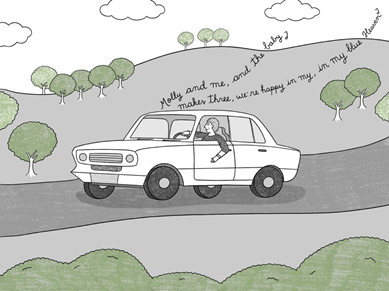
Erin driving her “steed” through England.
Illustration: Silvana Matassini & Camila Arévalo
Over time, Erin began to experience problems with her eyesight: cataracts. Losing the ability to drive marked a turning point, the confirmation of a new phase of life defined by increased dependency and fewer freedoms. The loss of the car was not merely functional; it transformed her autonomy and her relationship to space and time.
Her only son, Carl, is married and has two children. Erin maintains a close relationship with Matt, her youngest grandchild, who lives in Toronto. When Matt was younger, they travelled together often. Over the years, he invited her to spend Christmases, birthdays, and his university graduation with him.
In her everyday life, Erin navigates her mobility difficulties with the support of Carl, who visits her twice a week: on Mondays to take her to the knitting group, and on Saturdays with his family. However, his new job, requires frequent travel to Manchester, and sometimes months pass without seeing each other. During those periods, her daughter-in-law drops her off at the knitting group; at other times, Erin remains at home, rarely venturing out.
One of her neighbours, Peter, sometimes spends afternoons with her watching television. Both are widowed and have limited family networks. One afternoon, as they watched TV, Erin began staring at Peter with a look of strangeness.
“Are you all right, Erin? Do you need anything?” he asked.
Erin looked around and then said, “When did you come into the house?”
Peter thought she was joking and asked again if she was feeling well.
Erin appeared irritated and confused; after a brief silence, she recognised him again, nodded, and said, “Yes, I’m fine. Would you like some tea?”
During one of his visits to Hull, Matt suggested she attend a group for older adults to establish routines and socialise. Erin agreed. That was how she began attending the knitting group.
For Erin, the group meant sharing calm mornings with other women, drinking tea, chatting, listening to other’s routines and stories. It offered movement, noise, companionship.
That is where I met her. Erin was one of the first women to welcome me warmly, immediately offering biscuits and tea. She was deeply curious; for every question I asked, she had several in return. Her curiosity softened the encounter and allowed more sensitive topics to emerge organically.
Fragments
During one of my visits, Erin asked me whether I liked music. I suggested we listen to something together. She chose Blue Heaven by Frank Sinatra. I played it on my laptop and placed the headphones gently over her ears. She smiled as she listened, absorbed in the sound. When the song ended, she lingered with the melody for a moment, softly humming along. From there, almost without noticing, we slipped into conversation, about her life, her family, her road trips. Then a note of concern emerged.
“I don’t know what’s happening to me,” she said. “My son wants to take me to the doctor because the other day I struggled to recognise Louis—my other grandson—”
I told her that he was doing the right thing.
“Maybe I’m losing my memory,” she added.
Suddenly, she asked, “Have you been to Canada?”
“Not yet, is it nice?” I replied.
“Yes,” she said, “my grandson lives there. I wish you could go. Toronto is a beautiful city.”
I returned home thinking about my grandfather and our experience with Alzheimer’s. The diagnosis posed enormous challenges for my family. Sometimes my grandfather would remember me: “Silvana banana,” he would say. Other times he would ask, “Who are you?”.
Thinking about Erin, I wondered what would happen if the diagnosis were Alzheimer’s. She has one son who travels frequently; her closest grandchild lives far away. Who would care for her?
The following week, when I returned to the knitting group, Erin was upset. She sat silently, observing, so I kept my distance. From then on, changes in her behaviour became more frequent. Some days she was quiet, others, very talkative.
In work on dementia caregiving, Shapiro and colleagues examined fragments in medical records, drawing attention to the material forms through which lives can be partially reconstructed, clinical notes, documents, and dispersed traces across institutional settings. Attending to these forms highlights the materiality through which fragments are preserved, assembled, and made meaningful.
In my case, however, fragments are not material in the same way. They do not reside in documents, but in fleeting moments of interaction, in gestures, sounds, shared memories, and moments of confusion or humour. Yet, like those documented traces, they allow a person to remain present.
In one encounter, I asked what she would like to do if she could go out more often.
“Swimming,” she said. “Let’s go for a swim, I’ve got a bikini.”
I used that moment to ask about the doctor.
“They say I have mild dementia.” She replied.
“How do you feel?”, I asked.
“I feel old”.
I hugged her. In that moment, we were moving together through a moment of uncertainty. Before leaving, we shared tea in a corner. For Erin, being old meant “feeling lonelier”. Dependence worries and frustrates her. The diagnosis frightens her, even though she felt fine and had not yet noticed major changes.
In the weeks that followed, we did not speak about her diagnosis. The weather improved, and the city filled with cultural activities. One took place on the Lane Bridge, transformed into a musical installation: participants walked with headphones, listening to classical music.
Several women from the knitting group attended. Erin walked slowly, listening carefully. At one point she turned to me and said smiling, “If Frank Sinatra were playing here, it would be even better.”
“Molly and me, and the baby makes three
We’re happy in my, in my Blue Heaven”
These musical repetitions became another way of staying connected to her.
Monday arrived, along with another meeting. Erin appeared leaning on her daughter-in-law’s arm. This time, her daughter-in-law remained throughout the entire session. Erin had brought biscuits for everyone.
“They don’t want to leave me alone. I won’t be able to escape.”
It was clear to me that the family was reorganising around the diagnosis. Her son was often travelling, and she was now being cared for by his wife, Lilian. Their routines shifted as they collectively responded to what was unfolding, an example of how illness is often managed not individually, but through shifting networks of care and decision-making.
These fragments did not belong to Erin alone. They emerged within relationships. Care itself became reorganised through these shifting moments of recognition and disconnection. To be with Erin was to inhabit these fragments together.
What remains
Over the next two weeks, I could not attend. When I returned and did not see Erin, anxiety surged. I imagined the worst. Anna, one of the participants, told me that Erin’s grandson Matt was visiting. I felt reassured. But weeks passed, and Erin did not return.
Rachel, the NGO administrator, later explained that Erin was now being cared for by a distant cousin. It was no longer safe for her to be alone. She had fallen on the stairs and frequently forgot basic tasks. Her son had decided she should stop attending the group.
In September, after almost two months, Rachel called me. Matt wanted to meet me. Erin had spoken about me. I went immediately.
There they were: Matt and Erin, seated in a wheelchair, thinner than before. She was smiling, but she did not recognise me. Matt explained her memory now came and went.
During one lucid moment, he said, Erin asked him to bring something for me. Erin held a postcard.
“Gran, give Silvana the postcard,” he said, pointing towards me.
She handed it to me. I thanked her, looking into her eyes.
It was an image of Toronto. She had wanted to encourage me to visit. (Now, after many years I live in Canada, not that far from there.) I was deeply moved. Witnessing her experience of Alzheimer’s through the fragments we shared, through music, stories, gestures, images, and small acts of recognition, allowed me to see not a person disappearing, but one whose ways of being in the world were changing, yet still present.
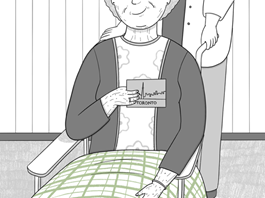
Erin about to hand me the postcard; behind her, Matt, her grandson.
Illustration: Silvana Matassini and Camila Arévalo.
Later, after some walking and conversation, it was time to eat. Matt asked if she wanted pasta; Erin nodded enthusiastically.

Erin’s gift: a fragment of our encounter.
Photo by the author.
Author Bio: Silvana Matassini Eyzaguirre is a Peruvian medical anthropologist currently working in the department of Global and Public health at McGill University. Her book project “Still Here: Ageing, Loneliness, and Resilience”, explores how older women navigate isolation, loss, and community across the life course. Blending ethnography with visual storytelling, it translates the emotional and sensory textures of ageing into a graphic format. The project examines how women make sense of their bodies, relationships, memory and everyday practices of care. It ultimately seeks to reimagine ageing beyond dominant narratives of decline, foregrounding resilience, connection, and lived experience.
Illustrator Bio: Cámila Arévalo Harman is a Peruvian architect turned digital Illustrator, with a postgraduate degree from Eina Centre Universitari de Disseny i Art, Barcelona.