
Kristin Hedges
Every semester I teach an introduction to medical anthropology undergraduate course. This course is a general education class within the health issues topic, which means that for most students, this is the first anthropology class they have ever taken. The core takeaway I want students to leave the course with is how our culture shapes the ways we see and understand health. I always begin the semester by introducing psychiatrist and anthropologist Arthur Kleinman’s concept that experiences of health and illness are culturally constructed. At the beginning of the semester, students struggle to wrap their heads around this concept. Their hard sciences classes have taught them that the symptoms and biology of illnesses or conditions are the same everywhere. Then we start to dig into the cultural context: how people talk about health conditions, recommend ways for handling them, and even structure policies around them differently across contexts. All of these variables impact how people understand and interact differently with the same label. Throughout 2025, we have seen this concept play out in my own country, the United States, as we have watched the cultural construction of autism shift from diversity of human brains to a focus on autism as an “illness.”
As the “medical freedom” movement gains popularity within American politics, a striking contradiction is unfolding. The same people demanding less government interference in personal health decisions are moving toward abject medicalization of neurodivergent people, reframing autism as an illness or disease, which culturally constructs it as an “epidemic” that needs to be prevented. As Zoe Gross, director of advocacy at Autistic Self Advocacy Network, stated, this reframing leads to “the implication of saying we need to end autism, that autistic people shouldn’t exist in our society,” which is both stigmatizing and damaging to the Autistic community.
The administration’s focus on finding the root causes of autism culturally constructs autism as an illness, which has prioritized a search for medical treatments, even backing an unproven treatment of Leucovorin. Autism is a very wide-spectrum, and some Autistic people may choose to utilize therapies and medications to assist with the challenges of navigating the world. However, to be clear, the American Medical Association and U.S. Department of Labor classify autism as a neurological and developmental difference, not an illness or disease.
Throughout this short piece, I will use recent examples to demonstrate that even with this understanding from experts, the Make America Healthy Again (MAHA) movement has returned to pathologizing and disenfranchising neurodivergent citizens. As a result, those elected to increase medical freedom and bodily autonomy for some people are simultaneously increasing coercion and undermining the dignity and autonomy of neurodivergent people. This rhetoric is changing the way people talk about autism along with recommendations around treatment and policies. As I will demonstrate, this rhetoric constructs autism as an illness, evident in the emphasis on identifying its underlying causes, efforts to amass private medical records, and claims that prenatal acetaminophen use or vaccination can cause autism.
The MAHA movement is the political vehicle for the long-standing “medical freedom” agenda. This agenda grew out of the concept of “healthism”, coined in the 1980s. Healthism was a growing health-consciousness movement that situated health and disease problems, along with solutions, at the individual level. Within this framework, citizens are encouraged and commended for exercising control over their own health and healthcare decisions. Healthism then expanded to include vaccination decisions. In the United States, healthism developed into the “health freedom” movement as early as the 1990s. The concept of health freedom merged easily with American understanding of individualism, which is at the heart of American culture. Throughout the COVID pandemic, the medical freedom movement resisted public health measures and policies aimed at controlling the spread of the infectious virus in deference to individual autonomy.
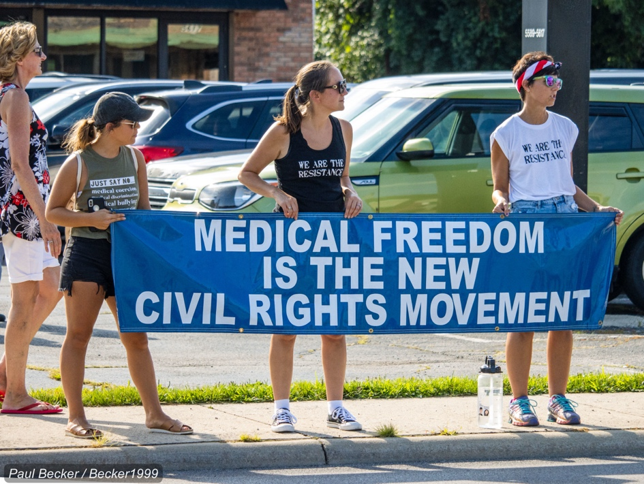
Photograph taken at an anti-vaccination protest Grove City, Ohio, on August 15, 2021. Photo credit: Paul Becker
Creative Commons: Becker1999 from Grove City, OH, CC BY 2.0 <https://creativecommons.org/licenses/by/2.0>, via Wikimedia Commons
At the same time as the rise of healthism and medical freedom, there was a growing increase in recognition and promotion of neurodiversity. The term neurodiversity grew out of conversations within an online community of Autistic activists and a publication by Judy Singer in 1999. The movement continues to grow, leading to a different cultural construction focused on advocating for a social model instead of a medical deficit model of understanding neurological differences. The medical model designs treatment and therapies to “fix” a disease or illness. Treatment focuses on making people conform to society’s expectations of “normal.” By contrast, a social model recognizes that neurodivergent people do not have an illness that needs to be fixed. Instead, their brains process the world in a different way. Just as illness and disease are culturally constructed, this framework can also be applied to understanding disability. The promotion of neurodiversity illustrates how cultural understandings of different ways of thinking can shift toward recognizing them as part of the normal spectrum of human variation. From this perspective, whether a condition is experienced as disabling is shaped not only by individual differences but also by the social and cultural environments in which people live. Individuals with neurologically diverse ways of thinking may experience disability when navigating societies structured primarily around neurotypical norms, which can create significant barriers and contribute to heightened stress and anxiety.
This neurodiversity-affirming lens has reduced levels of stigma for many neurodivergent people by affirming their value, expanding neuro-affirming treatment options, and advocating for supportive accommodations that utilize a strength-based approach. This shift highlights the diversity of humanity and the many ways that people experience and move through the world. There is more work to be done, further research, ongoing dialogue with neurodivergent advocates and communities, as well as other models that might offer a more tailored approach. Still, significant steps were made to move away from medicalizing neurodivergence. But in 2025, as indicated by the MAHA search for the root cause of autism, we saw a slide back toward the medicalization and cultural construction of autism as a disease needing medical “cures” rather than recognizing the variation in the ways people process the world.
As the medical freedom movement has grown and gained popularity since the 1980s, the MAHA movement has now placed these personal ideologies within political and governmental institutions. MAHA defends “freedom” when it addresses parents’ health care decisions, consumers’ choice in medications, vaccine skeptics, or sovereign health decision-makers. MAHA is not a blanket rejection of medicine or state authority; it is more about how the authority is being assigned. The effects of the medical freedom movement having political power are felt daily as we watch long-standing public health institutions move from protecting the public’s health to putting the public’s health at risk. The MAHA movement claims to focus on finding the “root causes” of chronic disease so they can focus on prevention while simultaneously questioning vaccines, the best prevention for serious childhood illness.
The MAHA campaign has particularly focused on finding the “root causes” of autism. In April 2025, HHS Secretary Robert F. Kennedy Jr. announced new plans to study autism by amassing private medical records from federal and commercial databases. While the idea was to streamline data resources for research, there was an immediate public outcry and alarm across the Autistic community concerning privacy rights. Days after the announcement, the Trump Administration walked back language denying plans to create a “registry.” “We are not creating an autism registry. The real-world data platform will link existing datasets to support research into causes of autism and insights into improved treatment strategies,” an NIH official told CBS News.
While the denial of an autism registry was a relief to many community members, concerns about MAHA’s medicalization of autism remain. Many Autistic people rely on diagnoses, therapies, medications, and accommodations that exist within the medical system. The same system, however, becomes a site through which MAHA promotes a particular form of medicalization that culturally constructs Autistic and Neurodivergent people as damaged, diseased, preventable, and in need of correction.
This contradiction is striking. On one hand, MAHA advocates for individual control over health decisions; on the other, it supports the medical authority to regulate autism. Measures such as vaccine-related rhetoric, prevention-focused discourse, and the pursuit of a “cure” all reflect a coercive, deficit-based model of medicalization. This approach is especially harmful because it treats autism as a national crisis to be solved rather than as a form of human diversity with its own contributions and needs.
On September 22, 2025, “President Trump pledged to address America’s skyrocketing rates of autism.” Throughout his speech, he used language to construct autism as a tragedy and disease. From his introductory sentence, President Trump used the medical model by calling it a “crisis of autism, a horrible, horrible crisis.” He went on to state that the rise in autism rates is among the most “alarming public health developments in history.” Throughout the rest of President Trump’s speech, he used phrases such as “severe problem,” “families destroyed over this,” “a tough situation,” etc.
This announcement was an extension of MAHA deficit-oriented framing of autism through fearmongering. Leaders within the autistic community described how this framework is offensive and harmful. As the executive director of the Association for Autism and Neurodiversity, Brenda Dater stated, “Misinformation about autism is not harmless. It shapes policy, stigmatizes people, and distracts from urgent needs.” Autism does not have one single cause; it arises from a combination of factors, with genetics playing the largest role.
Within this same announcement, the Trump administration discussed “mounting evidence of a connection between acetaminophen [commonly known as Tylenol] use during pregnancy and autism.” This statement promoted unsubstantiated claims and misinformation, as a population-based study in Sweden found no link between acetaminophen and neurodevelopmental disorders. Advocates from Embrace Autism, an Autistic-led organization created to support Autistic adults, responded to the claimed link between Tylenol and Autism: “For autistic adults, parents, and loved ones alike, these kinds of claims are painful. They suggest that autism is a preventable mistake, the result of something a mother did, and that narrative is scientifically misleading and stigmatizing.”
The claim that acetaminophen use during pregnancy causes autism generated significant concern among pregnant patients and medical professionals. Following the announcement, orders for Tylenol reportedly “plummeted” in emergency departments across the country. In response to these concerns, the American College of Obstetricians and Gynecologists (ACOG) issued a statement reaffirming that acetaminophen remains an appropriate treatment for pain and fever during pregnancy and that the available evidence does not support a causal link between prenatal acetaminophen use and neurodevelopmental disorders. ACOG also emphasized that untreated maternal conditions, particularly fever, can pose significant risks to pregnant patients and fetuses, including increased risks of neural tube and other birth defects.
Subsequent evidence suggests that concerns about acetaminophen affected clinical practice. Months after the administration’s announcement, emergency-department orders for acetaminophen among pregnant patients declined by 10%, raising concerns about potential undertreatment of fever during pregnancy. Rather than demonstrating that pregnant patients definitively experienced untreated fevers, this decline illustrates cultural construction in action by demonstrating how public claims about the risks of acetaminophen may have influenced the use of a medication that ACOG continues to recommend when clinically appropriate.
While MAHA defends “medical freedom” for some, including vaccine decisions, the movement is reclaiming an old, debunked notion that vaccines cause autism. On November 19th, 2025, the CDC changed its website to state, “The claim ‘vaccines do not cause autism’ is not an evidence-based claim,” reviving a thoroughly discredited link between vaccines and autism. A supposed link between the MMR vaccine and autism was originally published by Andrew Wakefield et al. in The Lancet in 1998 and later retracted in 2010 because of scientific misrepresentations, undisclosed financial interests, and other ethical violations. Wakefield later lost his medical license in the UK, moved to the United States, and continued to profit from his anti-vaccination movement.
Reviving this debunked claim of a link between vaccines and autism instills fear and doubt over the safety of vaccines that are essential for controlling infectious diseases. The American Medical Association immediately released a statement: “The AMA is deeply concerned that perpetuating misleading claims on vaccines will lead to further confusion, distrust, and ultimately, dangerous consequences for individuals and public health.”
Beyond instilling fear and doubt over the safety of vaccines, this rhetoric from the government damages neurodivergent people by pathologizing and instilling fear over different neurotypes, equating autism to a dangerous infection that people should try to avoid “catching.” This cultural construction of autism recasts it as a disease and distorts our understanding of this neurotype as a pathogen.
The Autistic Self-Advocacy Network was founded in 2006 with the core belief that “the autism world would be better served by ending the misguided search for a ‘cure’ and focusing on empowering and supporting Autistic people and all people with disabilities to live the lives we wanted.” Recasting autism as pathology invites a slide toward institutional authority, inappropriate and harmful interventions, as well as the erosion of self-advocacy within the Autistic community that has fought for decades to secure dignity and autonomy.
Back in my classroom, we continue to examine the cultural construction of disability. Neurodivergent students often raise their hands to share their experiences, while other students reflect on how little direct experience they have had with autism. Over the past year, however, I have increasingly heard those students with no personal experience with autism reproduce an older cultural construction of autism as an “illness” in need of a “cure.” This shift has reinforced one of the central lessons I hope students take from my classes: culture is fluid. Ideas, norms, and beliefs about health, illness, and disability are continually constructed, contested, and transformed. In the United States, while understandings of autism had shifted from an emphasis on illness and cure toward greater recognition of neurodiversity, now, in some contexts, it is shifting back toward medicalized understandings of autism. But this history also reminds us that no single cultural construction is inevitable. If our understandings of autism and disability are culturally constructed, they can also change. Recognizing that these ideas have histories shaped by people and institutions creates a space to imagine and participate in shaping a more positive and affirming understanding of disability in the future.
Dr. Kristin Hedges is an associate professor of anthropology at Grand Valley State University in Michigan. She is an applied medical anthropologist with a focus on using community-based ethnographic research approaches to understand local cultural construction of health, illness, and risk. She publishes to a broad, interdisciplinary audience through journals such as Journal of Ethnobiology, Journal of Youth Studies, Anthropology and Medicine, and Human Organization. Dr. Hedges’ forthcoming book Yieyio: Maasai Women Navigating Motherhood in a Changing World tells the story of a domestic violence survivor and traces the pathway to motherhood across generations within one Maasai family in Kenya, check out the book trailer.