Silke Oldenburg, Armand Mulume Bisimwa, Daniella Bugugu Mapendo
One morning in March 2026, in a workshop room in Bukavu in eastern DR Congo, a community health worker leans over a flipchart. Her group has been asked to list the difficulties they encounter in their work, and she writes the first one down in her own hand: “Manque de Visibilités: cartes, gilets.” A lack of visibilities, cards and vests. On the solutions chart, the same group proposes that if no one else provides badges, the relais communautaires, or RECOs, will procure them themselves.
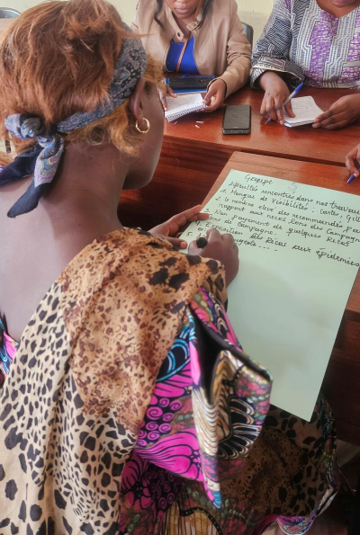
Figure 1. “Difficultés rencontrées dans nos travaux: 1. Manque de Visibilités: cartes, gilets.” Co-design workshop with relais communautaires, Bukavu, March 2026.Photo: Silke Oldenburg
We take this handwritten sentence as our starting point because it condenses, in five words, a whole theory of care under abandonment. RECOs are volunteers. They hold up the first line of care in a health system that has been chronically underfunded for decades, shaped by three decades of recurrent armed conflict and its renewed escalation since early 2025, when the rebel group M23 took first Goma and then Bukavu, strained by successive epidemics of Ebola, mpox and measles, and marked most recently by the retreat of USAID, one of its largest donors. They go house to house, refer sick children, trace contacts, talk families through vaccination campaigns. What they ask for, before money, before medicine, is to be seen.
In the discussion groups, the demand kept returning with the same scene attached. “If we wear our visibilities, we are well received,” one participant explained. “If we have no visibilities, they take us for thieves” (si nous n’avons pas de visibilités, on nous prend comme des voleurs).
Without a sign, a carer at the door is not simply anonymous. She is a stranger who wants to come in, and in Bukavu that is enough to make her suspect. A vest treats no one, and a laminated card refers no child to a health center. What the sign does is place its wearer inside a relation. It tells a wary household that the woman at the door acts on behalf of something larger than herself. It converts an individual, whose neighbors know her as a farmer or a churchgoer, into the visible edge of a health system. Knowing that care which cannot be seen can be denied and disowned, the RECOs ask for a badge, and with it for recognition in the fullest sense of the word: a durable, material sign that they belong to an order that answers for them.
The scenery of withdrawal
To understand why a piece of laminated plastic matters this much, one has to walk through the facilities where RECOs deliver their referrals. In a health center pharmacy in Kadutu, donated cartons are stacked to the ceiling, their sides stamped “Not for retail sale.” In an empty ward, a USAID sticker is fixed to the frame of a bed that stands beneath a crucifix. The two signs, one of humanitarian provenance and one of divine protection, watch over the same absence.
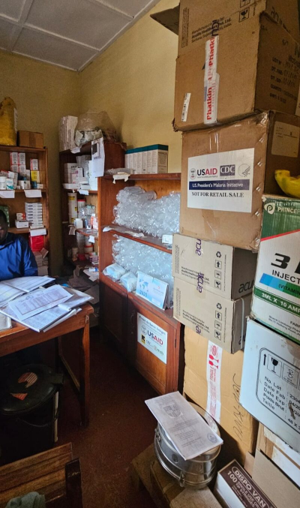
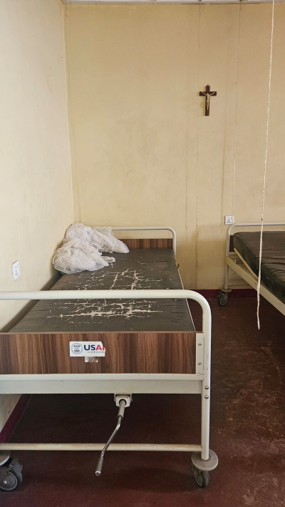
Figure 2. “Not for retail sale”: a health center pharmacy, and an empty ward with a USAID sticker beneath a crucifix. Kadutu.Photo: Silke Oldenburg
In Nyantende, the office wall of the aire de santé (health area) is its own archive. Hand-drawn maps of this area, consultation tariffs listed in dollars, ambulance phone numbers, all of it handwritten, taped and retaped. Each sheet on it is a relation in material form. A map assigns households to the aire, a tariff quotes them a price, a phone number promises that an ambulance will come. When institutions leave, their paper stays, and the relation survives on one side only. The wall goes on announcing a system while the organizations that once financed it have wound down or withdrawn.
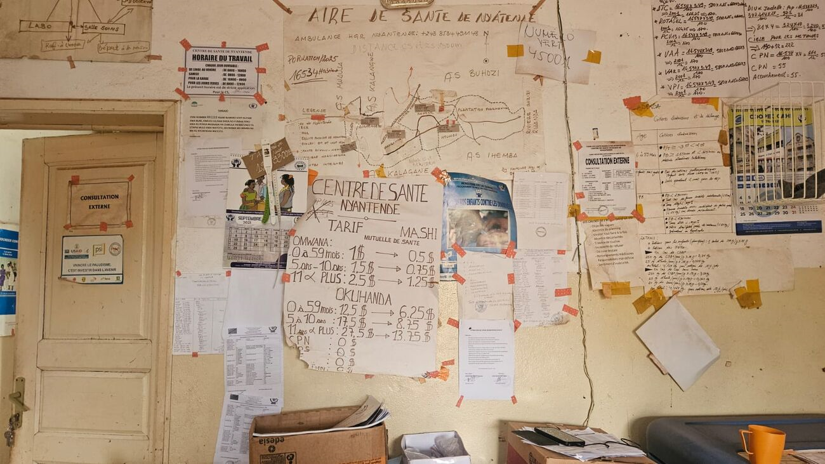
Figure 3. The wall of the aire de santé office: hand-drawn maps, dollar tariffs, ambulance numbers. Nyantende. Photo: Silke Oldenburg
Donor retreat has a material afterlife. Describing what it means to go on home visits without a sign of her own, one woman said: “They send us to the field without visibility, and we go anyway, for lack of choice, to help the community fight disease” (on nous envoie sur terrain sans visibilité, nous y allons seulement par manque de choix). “They accept us in the community only because they know us” (ils nous acceptent uniquement parce qu’ils nous connaissent). Where institutions recede, recognition shrinks to the radius of personal acquaintance. A badge, in this light, is a claim to be recognizable beyond the streets where one is already known, in the next quartier, at a checkpoint, at the door of a household that doesn’t know one’s face.
Branded visibility
What identifies a RECO today usually carries someone else’s name. In Kadutu we photographed a man from behind, wearing a t-shirt printed with the word RECO in large letters, framed by the logos of USAID, UNICEF and INTERSOS. The programmes that paid for it have wound down, and he still wears it to work. Vests circulate from one vaccination campaign to the next, worn by whoever is mobilized that week.
Donor retreat has a material afterlife. Describing what it means to go on home visits without a sign of her own, one woman said: “They send us to the field without visibility, and we go anyway, for lack of choice, to help the community fight disease” (on nous envoie sur terrain sans visibilité, nous y allons seulement par manque de choix). “They accept us in the community only because they know us” (ils nous acceptent uniquement parce qu’ils nous connaissent). Where institutions recede, recognition shrinks to the radius of personal acquaintance. A badge, in this light, is a claim to be recognizable beyond the streets where one is already known, in the next quartier, at a checkpoint, at the door of a household that doesn’t know one’s face.
Branded visibility
What identifies a RECO today usually carries someone else’s name. In Kadutu we photographed a man from behind, wearing a t-shirt printed with the word RECO in large letters, framed by the logos of USAID, UNICEF and INTERSOS. The programmes that paid for it have wound down, and he still wears it to work. Vests circulate from one vaccination campaign to the next, worn by whoever is mobilized that week.
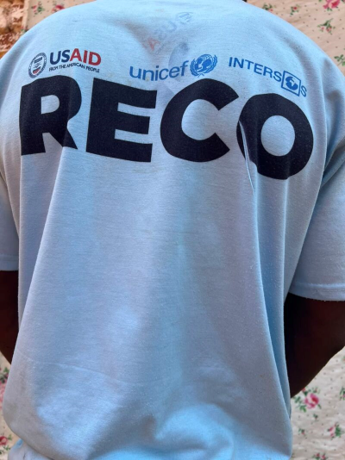
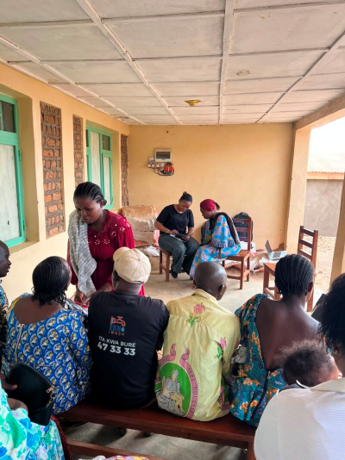
Figure 4. Borrowed names on a RECO’s back, and badge registration underway on a health center veranda. Bukavu, July 2026. Photo: Armand Mulume Bisimwa.
A logo, here, is never only a picture. Worn on a body, it tells the community a story about money: where it comes from, who channels it, who profits. For the RECOs this story becomes a trap, and they can quote it in figures. “The population believes we have a monthly salary. Some speak of a hundred dollars a month, others of eighty,” one participant reported. “When we try to explain that we are volunteers, they do not understand at all” (quand nous essayons de leur expliquer que nous faisons du bénévolat, ils ne comprennent pas du tout). The rumored salary has exact amounts and condenses everything the community believes about a system that pays, profits and extracts while the money never reaches the people wearing its logos.
Being seen in borrowed colors also has a domestic price. “It is not normal that I should have to ask a neighbor for salt when he has seen me wearing the vest, carrying my files on home visits,” another RECO said. “In the neighborhood they have already started calling us the sufferers” (dans la cité on commence déjà à nous appeler des souffrants), highlighting the gap between appearance and income.
This is the ambivalence in our title. The demand for visibility is not naive. RECOs know exactly what a sign on the body does, in both directions. In asking for badges with their own names and faces, they are asking for a different kind of visibility: one that identifies them as themselves, as named persons accountable to their neighbors, rather than as the walking surface of an absent donor. And yet, when the badges were finally in their hands, the first thing they asked us for was more borrowed markers. “Add the stamps or signatures of the provincial health division or the health zone, and put the words LAISSEZ-PASSER on it,” one RECO proposed. “You could also put other logos, like the WHO, to help us pass the barriers the politicians keep up. If he sees that, he can tell himself, this is a health worker” (s’il voit ça, il peut se dire, c’est un agent de la santé). The same logos that make a RECO look like the paid agent of a distant organization are the marks that get her through a roadblock.
The interval
In July 2026, our project responded to the flipchart. Together with the health zone, we registered 270 RECOs for photo ID badges. Names were entered into tablets on a health center veranda, portraits were taken, one by one, for a document that did not yet exist. We wrote most of this essay from inside the interval between the demand and the object, the weeks in which RECOs had been photographed and registered but not yet badged.
Ethnographically, this interval is not dead time. It is the moment in which the meaning of the badge is still open. Waiting for a document is its own condition, and the RECOs wait the way one waits for something that has been promised before, hoping and doubting in turns. Hoping, they imagine a badge with their own name and face opening doors that borrowed vests never did.Behind it stands a larger wager that many RECOs attach to the work itself: that years of unpaid service, once made visible and documented, might eventually lead somewhere, to training, to a position, to being first in line when the health system one day hires the people who have been holding it up for free. The doubts are just as concrete: Will the badge be honored at checkpoints and doorways? Will it outlive the project that produced it, the way the USAID t-shirt outlived its program? Will being seen protect, or expose? A badge may reduce the risk of being mistaken for an intruder, and it may just as well mark its wearer as the agent of a system people have learned to distrust. For now the badge can still be either, the sign the flipchart asked for or one more garment in the pile of borrowed colors.
The RECOs pose this question themselves, and they also push it past the object: “Visibility is not only that,” one participant insisted when the groups discussed what should be done. “Visibility can also mean valuing the role of the RECOs in the community” (la visibilité peut vouloir dire aussi de valoriser le rôle des RECO dans la communauté), moving the discussion from textiles to recognition.
We close with a photograph of a blue suggestion box on a yellow wall of a health centre in South Kivu. It is a modest object with a large claim: that the people a system serves, and the people who volunteer to hold it up, have something to say about it, and that someone will open the box. The RECOs’ flipchart was such a box, opened. In late September 2026, the first badges reached their owners, in the same workshop room, in front of the same flipchart sheets. The RECOs read the card in the terms of their present. One held it next to the document most Congolese carry as identification: “My own voter’s card is no longer in good condition. I can use this as a pass” (moi-même ma carte d’électeur n’est plus en bon état, je peux utiliser cela comme laissez-passer). Another described what it does for a colleague: “Wherever she goes, even in another province, she can present this card where other relais are, and she will be integrated right away” (partout où elle ira, même si c’est dans une autre province, elle peut présenter cette carte là où d’autres relais se trouvent et directement elle sera intégrée). The recognition, which had shrunk to the streets, where one is already known, extends here to the next province. The cards went back the same week, to be stamped by the health zone, as the RECOs had asked. We had expected the interval to end with the distribution. Instead the RECOs prolonged it themselves, waiting a few more days for the stamp that gives their card its credibility.
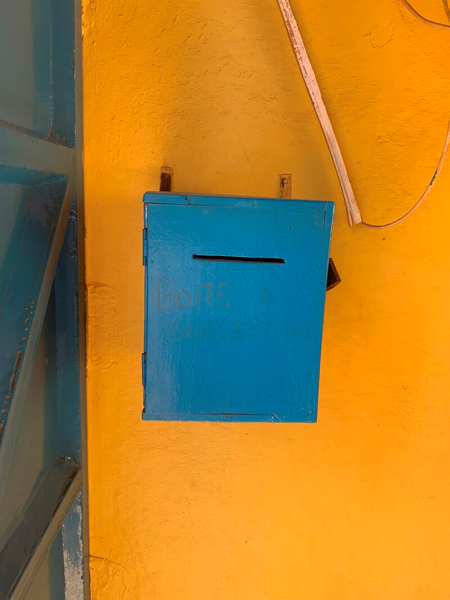
Figure 5. “Boîte à suggestion.” A health centre wall, South Kivu. Photo: Armand Mulume Bisimwa
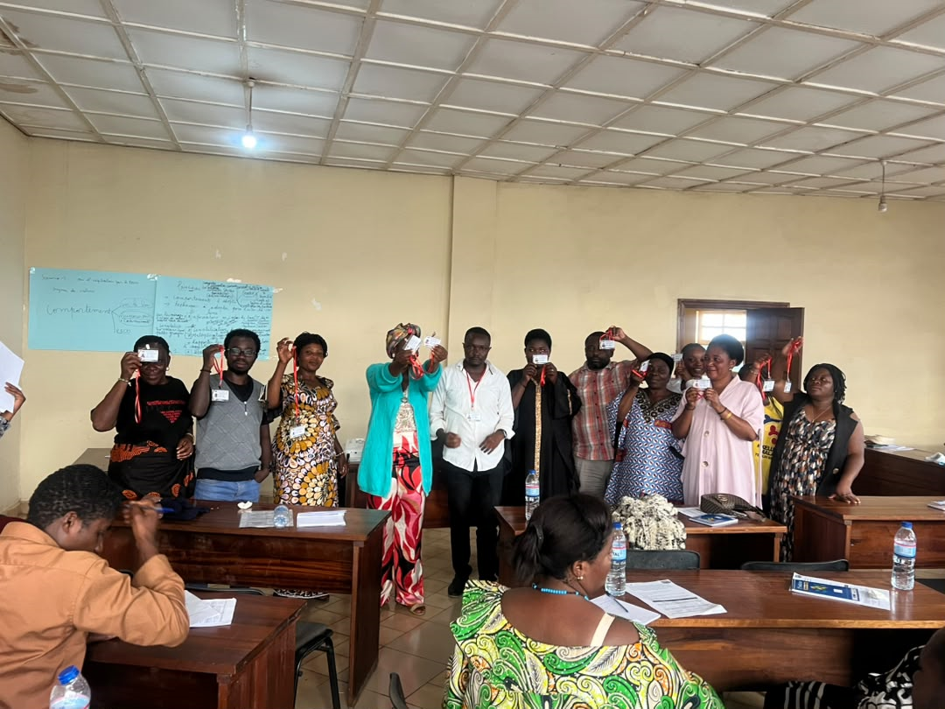
Figure 6. Badges held up in the workshop room, the flipchart sheets of the training behind them. Bukavu, September 2026. Photo: Daniella Bugugu Mapendo
Who may be seen as a carer, under whose name, and at what risk, is decided in cloth and laminate as much as in talk, in rumored salaries and street nicknames. “Manque de Visibilités” is the RECOs’ own analysis of this politics.
—
A note on language: The workshop and training discussions took place in Swahili. Quotations follow the French transcripts and notes prepared by the research team and were translated into English by the authors.
—
Author bios:
Silke Oldenburg is a senior researcher at the Geneva Graduate Institute. As an anthropologist, she works on humour, care and infrastructure in cities shaped by armed conflict and environmental change in eastern DR Congo and coastal Colombia. She leads the ethnographic research in the SNIS project Caring on the Frontlines on community health workers in South Kivu.
Armand Mulume Bisimwa is a public health researcher based in Bukavu, South Kivu. He has extensive field experience conducting research and health surveys in health zones affected by crisis and insecurity in eastern DRC. His work focuses on strengthening health systems and improving community health, with the aim of generating evidence, understanding local health challenges, and contributing to context-specific solutions to address the needs of populations and health actors.
Daniella Bugugu Mapendo is a medical doctor and research assistant in public health at the École Régionale de Santé Publique of the Université Catholique de Bukavu. She has extensive field experience conducting research and health surveys in health zones affected by crisis and insecurity in South Kivu. Her work focuses on violence within healthcare systems, with the aim of generating evidence, understanding its underlying causes and consequences, and contributing to context-specific solutions to address the challenges faced by healthcare workers and health systems.