Glorieuse Uwizeye and Sienna R. Craig (corresponding author)
Glorieuse and Sienna met when Glorieuse was a postdoctoral fellow in the Department of Anthropology at Dartmouth College, where Sienna is a professor, and soon found that they shared a belief in the vitality of storytelling. Glorieuse’s research centers the biological, psychological, social, and epigenetic effects of human trauma within a broader framework of commitments to global health, human dignity, and equity. A survivor of the Rwandan genocide, she is also a nurse, a mother, a daughter, a sister, and a woman of faith. Her scholarship is grounded in these lived experiences. Alongside her commitment to research on global health, women’s and children’s health, Asian medicines, and the study of migration and social change, Sienna’s scholarship centers creative and experimental approaches to ethnographic writing. She has long engaged in collaborations across anthropology’s subfields as well as across disciplines and writerly genres. After Glorieuse left Dartmouth to begin a permanent academic position, she reached out to Sienna. She asked: Might we talk more about the arc of her life experiences as they relate to her academic endeavors? Might there be more stories to tell, beyond quantitative analysis? Sienna’s answer: an unequivocal yes. A dozen hours on Zoom later, we had created a small archive of conversations. This piece is one outcome of that effort to connect, and to reckon with what was shared, and what we learned from this process.
I am called Glorieuse Uwizeye. I am neither the eldest nor the youngest in a family of seven children. Rwanda is my home country. Rwandan state identity cards are no longer marked with ethnic groups—Hutu, Tutsi and Twa—we are all Rwandans first and foremost, but the impacts of these marks remain on our bodies, hearts, and minds.
Our family is bound by faith. My father was a Presbyterian pastor. My mother was a teacher in the countryside, before we moved to Kigali. There, the people around us were good but poor. We had a bit more: a car, a garage, a house with wooden windows near the church. Friendship and compassion shaped our childhood. Although my siblings and I had shoes, others did not. So, we went to school barefoot, our soles cracked alongside theirs. We played together in fields and orchards: banana, avocado, sorghum. This was the time of President Habyarimana, before his plane was shot from the sky and the Genocide against the Tutsi began. In my house, we heard our parents speak about the struggles for education, for equality. To be correct with God was most important. This kept them going. They achieved things.
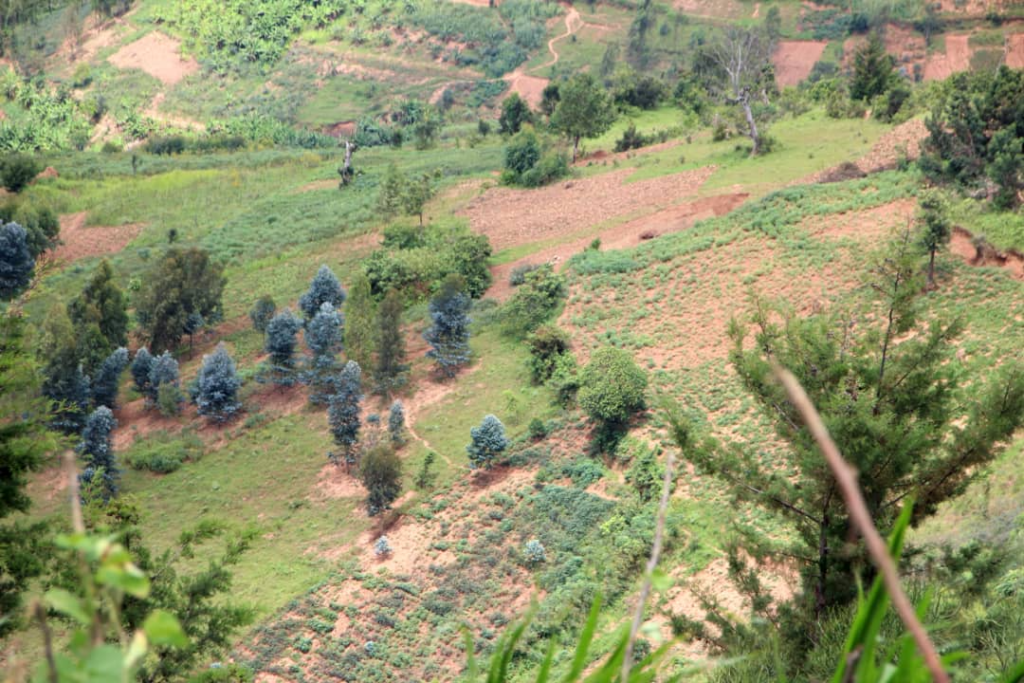
This is the hill where my paternal grandmother, my uncle’s family, and other extended family members lived. They were killed in the Genocide against Tutsi and their houses were destroyed. Now, we plant crops here but mainly keep it clean. Photo courtesy of Glorieuse Uwizeye.
Even before the Genocide, I knew about violence. My grandmother would repeat this story about how her brother was attacked. Before he could be chopped to death and thrown into a river, he jumped in, swam the other way, survived. This was not 1994. This was the 1950s. My father told me about people like us crossing borders, passing through bush at night, escaping. That was 1973. He taught me about courage and told me about prison, about not being allowed an education because of his ethnic group.
When it was my turn, somehow, I enrolled in high school. There, history class planted and watered seeds of genocide. We were snakes, cockroaches. Discrimination was our intimate companion. But so, too, was God.
“Your father is very clever.” I remember hearing this when I was young from his Hutu colleagues who had gone to university and enjoyed government jobs. Theology was my father’s calling, but it was also maybe his only path. He considered it a form of protection. In past moments of brutality, church had been a refuge. Not this time.
We were thirteen in our home in Butare during the Genocide against the Tutsi: my parents, two older sisters, four younger brothers, two cousins, a house helper and guard, and me. The house helper was Hutu. We had enough trust. He could fetch water. We were hidden in plain sight: lights out behind a brick wall. We locked ourselves in. My brothers and cousins were younger. Being silent was difficult for them. Some in my family stopped showering. What use is being clean if you could die tomorrow? When the water tap runs red with our people’s blood?
Hopelessness visited me, too. Sometimes at night when it was dark I would climb the cassava tree in our compound. From there, I could see the interahamwe eating brochette beside the prison. These were “those who stand and fight together” in Kinyarwanda—the name given to Hutu militias that organized and executed the Genocide. I imagined a machete death. This was a time when people would pay to be shot by a bullet. But we were too many for my parents to afford a bullet for each of us. I thought: Maybe I too will be chopped. But I knew that somehow God can save me.
Once, militia members came to our doorstep and asked for my parents’ identity cards. We could not hide what was written. They instructed us to walk to a forest. It was silent. Suddenly my mom began singing a hymn. It was like a vision. Even the killers waited. Before she finished her song, two men stepped aside and talked, then told us to return to our house and stay quiet. My father gave them what money he had. In this moment, somehow that was enough.
Later, my father saw an angel catch a bullet on our roof. My mother was visited by the Holy Spirit. Twice, the throne of God appeared to me beside our house, draped in white. We passed time with the Bible. Prayer is always sustenance, but then it became our feast. Somehow, we had just enough food for three months. Outside the compound, our extended family was killed. Rwanda’s hills were emptied of so many Tutsi families, but for ghosts.
Afterwards, it was as if we were living a bonus life. I was tired, but I found my way to nursing and mental health. This path, paved by the Church, took me to South Africa, where I kept studying. When I returned to Rwanda, my focus turned to women and children, including those born from genocidal rape. I knew about DNA, but learning about epigenetics was like a lightning bolt. The phrases “global mental health” and “health equity” settled into me as questions that needs answers: How does this trauma play out? How is transmitted across generations?
The miracle of survival is also the miracle of education. The miracle of education is also the miracle of science. The miracle of science is also discovering what is already there, by the grace of God. It is up to human beings to find a way to live through what we do to each other. To allow each other to live. And to live with what our bodies remember.
Postscript Reflection
This flash ethnographic essay emerged through dialogue. Our writing process involved condensing many hours of conversation between two people, yet we chose to craft the piece in the first person. This decision centered Glorieuse’s voice and built from her earlier efforts to write about the relationship between her family’s story and her professional trajectory with historical fidelity and emotional honesty. Sienna spent time with Glorieuse’s earlier text as well as the notes from our discussions to whittle both corpuses into a narrative arc, in keeping with flash’s condensed form. Flash encourages vernacular precision. Sienna worked to preserve a sense of Glorieuse’s tone, turns of phrase, spoken rhythm. We then passed drafts back and forth before arriving at a text that felt spare and spacious yet complete. We hope this short piece will also lead to a longer form piece of writing and continued collaboration.
As a professor in Western University’s Arthur Labatt Family School of Nursing, Glorieuse Uwizeye’s interdisciplinary scholarship expands current understanding of intergenerational health effects of exposure to socio-political and racial violence, including the Genocide against the Tutsi, and aims to understand and address health inequity through collaborative and community-based epigenetic and biocultural research that centers anti-colonial approaches to trauma and violence care.
A medical and cultural anthropologist whose scholarship is grounded in collaborations with Himalayan communities in Asia and North America and in diverse practices of ethnographic writing, Sienna R. Craig is the Jane and Raphael Bernstein Professor in Asian Studies at Dartmouth College.
This essay is part of the series “Flashes of Responsibility: Craft, Ethics, and Impact in Global Health Ethnography,” co-edited by Liana Chase,* Marlee Tichenor,* and Sienna Craig.
*Chase and Tichenor are co-first editors of the series.