Minsu Yoo
Several months have passed since returning from the EAMAN conference in Taipei, yet my thoughts still resist settling. The event lingers in shards, like objects left scattered after a hurried departure. Writing desks, footsteps, faces, screens, hands, and voices carrying from wall to wall. Our presentation panel, titled Matters of Care in Psychedelic Medicine: Ethics, Aesthetics, and Cultural Transformations, stood at the very beginning of the two-day program.
Our project took shape from the recognition that the growing institutional presence of psychedelic-assisted therapies (PAT) in East Asia brings practices of care, spiritual cultivation, and medical innovation into patterned interaction within clinical and regulatory regimes. Although PAT has been shaped by Western biomedical discourse, its uptake in East Asian contexts exposes tensions between local epistemologies and international drug governance. These tensions surfaced through our collective work: Chia-Ying Kuo’s examination of the “double colonization” of psychedelics in East Asia, Xiaofan Sun’s ethnographic research on esketamine-assisted therapy in Taipei, and my own comparative study of how these tensions materialize in lived practices of care and in the phenomenology of therapeutic encounter.
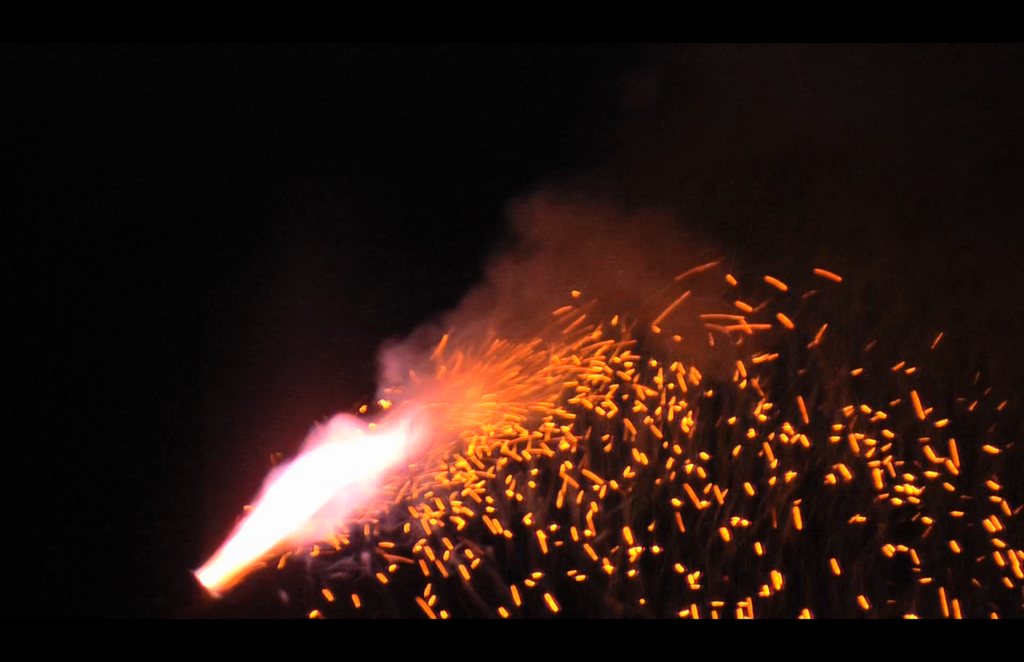
Firework in Miaoli mountain at lotus lake, Photo by author.
The approach inhabits a zone of regulatory ambivalence: psychedelics are neither fully legalized nor entirely suppressed, but remain available through informal trade, experimental protocols, and discreet therapeutic use. That ambivalence shaped my preparation for the panel, especially in the effort to find a language at once precise and sufficiently capacious to register both the risks and the intimacies of the work. Within scientific regimes that suspend nonsecular traditions of self-cultivation, the articulation of “care of the soul” encounters limits of translation.
The difficulty of conveying such experiences is sometimes more easily overcome in conversation. Inviting me to a meal at her family home in Shulin (??), a district of New Taipei City where she was raised, Momo taught me this. Now a sound artist engaged in environmental advocacy, Momo had described in earlier interviews the landscape of her childhood: narrow paths along flooded rice paddies reflecting the sky, bamboo groves moving in the wind, frogs sounding from the irrigation channels. “I can still see those paths,” she told me. “Walking beside the water, looking for baby frogs or insects.”
By the mid-1990s, those paddies had begun to disappear. Illegal furniture and textile factories slowly took their place, bringing the chemical smell of wood varnish and synthetic dyes that still hangs faintly over the neighborhood. The soundscape shifted too—the steady night-time rhythm of her mother’s sewing machines blended into the larger hum of industrial motors and traffic.
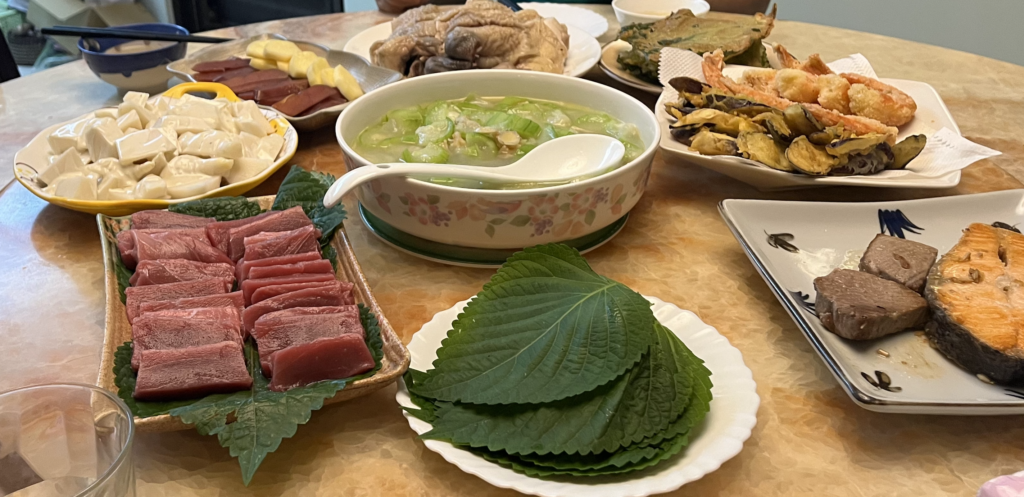
Dinner table prepared by Momo’s mother in Shulin, Photo by author.
She described how psychedelics led her back to a sense of being “part of everything”—a feeling she remembered from playing in the fields but that had become “less accessible” as she developed what she called an adult ego. “The boundaries fade,” she explained. “I’ll look up and see a speck of dust or a stain on the wall, and I’ll feel: that’s part of me, and I’m part of that.” This dissolution of the me-versus-world division became central to my understanding of how psychedelic integration reshapes one’s relation to home.
A question had already begun to take shape in my notes: How does a sense of home shift through psychedelic integration, and what infrastructures of trust can be built in the set and setting of therapy? Listening to Momo speak of paddies that no longer exist and of a renewed sense of belonging to the environment, I realized that her reflections were not only autobiographical but also methodological, pointing to home as something continuously recalibrated rather than simply remembered.
From there, the question extended across my interlocutors’ trajectories. Momo, based in Taiwan, lives in what I have come to think of as a condition of ongoing adjustment, improvising practices of care between the materially transformed landscape of Shulin and the lingering sensory memory of its rice paddies. Jojo, working in Germany as a sound artist and activist with a background in medicine and theater, articulates “care of the soul” within a different therapeutic and aesthetic lineage, one shaped by European psychiatric traditions and postindustrial urban life.
In my presentation, I brought their voices together—interviews, sound recordings, fragments arranged into a shared sonic landscape. I drew on Glenn Albrecht’s notion of “solastalgia”—the place-based distress experienced when home environments undergo ecological change beyond one’s control. By the time I stood at the lectern, it no longer seemed important whether my work fit neatly into a recognized academic discourse. The aim was to transmit a texture of experience, to make audible the fragile atmospheres of care and estrangement interlocutors inhabit.
The scattered pieces carried into the panel were not meant to stand apart from the polished case studies in other conference rooms. They resonated across scales, each a response to the question of how life is sustained as conditions shift—when the croak of frogs or the promise of family care gives way to new regimes of maintenance. Chia Ying examined how grassroots harm-reduction movements in East Asia assert agency within the global psychedelic renaissance, challenging both drug-control orthodoxies and the selective appropriation of Asian philosophies. Xiaofan, working in psychiatric clinics, traced how patients’ affective and spiritual experiences are translated within medical institutions, where therapeutic efficacy is often reduced to neuropharmacology.
If solastalgia names the ache of losing a world, then long-term care is one attempt to govern that loss, to render sustainable the inevitability of decline. The conference’s theme of super-aging drifted like weather across sessions and hallways, connecting our panel’s concerns to broader transformations in East Asian societies, where modernization has unfolded less as rupture than as accretion: older bureaucratic forms layered with new vocabularies of “contract.” What endures is maintenance—the habits and routines through which life is sustained within shifting systems.
Korea, Taiwan, and Japan share a certain geopolitical likeness, though not sameness: a resonance complicated by postcolonial history. It can be felt in phrases like “you’ve worked hard (????/????/???),” threading intimate and public registers; in the way streets arrange themselves around schools and clinics; in the way elders’ bodies become arguments about futures. Yet asymmetries persist—of funding, of language, of what counts as evidence. In the conference hallways, I learned again that collaboration is never innocent, but it can still mean companionship: an arm on a shoulder in the corridor; a message after a session with a link to a paper; a shared complaint about the bell that slices across a thought just as it begins to breathe.
The challenges of our panel resonated with these broader questions of collaboration across differences. How do we sustain partial connections when working across distinct cultural contexts of psychedelic medicine? How do we maintain the tension between scientific frameworks and spiritual paradigms without reducing one to the other? Our collective work suggests that the task is not to resolve these contradictions but to document them with precision—to show how truths about care, consciousness, and healing travel, gather allies, and fracture in new contexts.
Now it appears as a fractured commons: voices scattered and precarious, held together by uneven, temporary alliances. By refusing to smooth over the dissonance between a clinical trial and a soundscape, or a policy brief and a visceral memory, we keep these “shards” of experience from being swept away. This requires practices of maintenance: circulating unfinished work, translating concepts without collapsing difference, acknowledging asymmetries in funding and authority while continuing to speak across them. Collaboration becomes ongoing negotiation, an agreement to remain in conversation even when consensus proves impossible.
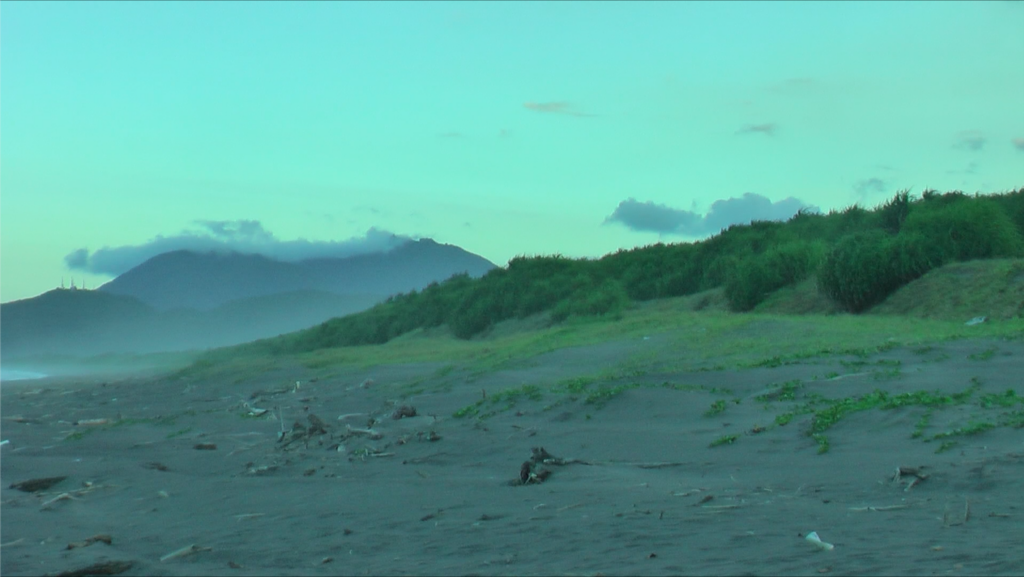
At a beach on the pacific coast in Yilan, Photo by author.
To speak of super-aging, the conference’s central theme, is to speak of how loss, governance, labor, and death intersect with genealogies of trauma and experiments in the care of the self when the autonomous self is limited under affective duress. In this sense, the question of home and the question of policy are not far apart. Our panel’s engagement with psychedelic medicine revealed how these intersections manifest in therapeutic settings: insurance schedules and soundtracks, clinic waiting rooms and aesthetic encounters with altered consciousness all belong to the same terrain. A system is a promise; a practice is how the promise is kept or broken.
What remains is juxtaposition: fragments aligned side by side, producing a collective account precisely in its dissonance. Medical anthropology works within these intervals, where what is partial and provisional nevertheless matters.
Home begins to resemble a foundation pit, where past attachments and anticipated futures accumulate. In an age of super-aging, care infrastructures quietly stage encounters with finitude: a future practiced in advance through the infrastructures of care, the promises of longevity science, the demographic curve bowed under the weight of the old. These practices return in altered form, reminders that departure is never total. Thus, home appears less as a bounded site than as a corridor or ward—spaces where consciousness shifts and where survival and loss remain entangled.
Author Bio: Minsu Yoo is a doctoral researcher in Anthropology at The New School for Social Research and in Sociology at RWTH Aachen University. Their work explores psychedelic medicine, ethnobotany, and the politics of care across Taiwan, Germany, and the United States. Yoo also develops sound-based ethnographic methods and collaborates on film and artistic research projects. They are a member of the PsychedELSI group and the Psychedelic Humanities Lab, and guest editor for a forthcoming BioSocieties issue on psychedelic psychiatry.