Loretta Lou
For over a decade, I have been studying what motivates ordinary people to take environmental responsibility in Hong Kong. Following a period of political unrest that began in 2019, which resulted in a widespread mental health crisis in Hong Kong, I began to explore what taking responsibility means in the context of mental health. In medical anthropology, responsibility is often critiqued as a form of neoliberal governmentality that overlooks broader social structures and the inequalities they perpetuate. However, in mental health care, self-help and the commitment to take one’s mental health seriously are both necessary and conducive to better prognosis. This flash ethnography explores the complexities of responsibility as experienced by individuals grappling with mental health conditions and considers the opportunities and limitations that self-help affords.
While most were still reveling in the festive atmosphere of Chinese New Year, LY, a former broadcast journalist, tragically took his own life by burning charcoal in his apartment. Known for his fearless reporting under extreme conditions, his investigative journalism had earned him widespread acclaim. However, shifts in Hong Kong’s media environment eventually led LY to leave journalism and reinvent himself as an online influencer and communication coach. His suicide sent shockwaves through the city, leaving many to grapple with the dissonance between his optimistic public persona and his hidden despair.
In the hours after the news broke, the search for explanations intensified. The public sought to pinpoint responsibility for his suicide. People claiming to be confidantes of LY suggested that he had never fully recovered from his divorce, and that his current relationship had left him feeling hopeless. Some pointed to the end of his career, constrained by a tightening media climate and his outspokenness. Depression and post-traumatic stress disorder (PTSD) were frequently mentioned, with many linking his mental health condition to a violent attack he and others endured—an event he chronicled in a critically acclaimed investigative book.
I was shocked. Just the night before, I had shared videos of him teaching people how to cultivate a “positive mindset” and how to “live with resilience” with friends on Facebook. LY had always seemed composed and confident in front of the camera. How could this be possible?
Trying to process the news, I messaged Jo[i]: “Smiling depression is claiming too many lives these days.”
She replied: “After 2019, who doesn’t have depression in Hong Kong?”
Jo wasn’t being dismissive. A survivor of childhood and domestic abuse living with the diagnosis of depression and PTSD, she understands what mental health struggles are like.
Although awareness of mental health has increased since superstar Leslie Cheung died by suicide in 2003, celebrities and public figures in Hong Kong tend to frame their depression as a “chemical imbalance” that is treatable with medication. While psychiatric medication has helped many, the current mental health crisis—triggered by the pandemic and the collective trauma from the social unrest in 2019—cannot be resolved with medication alone. We speak of depression as the cause, but sometimes it is actually the effect. As Jo put it: “The current mental health crisis has deeper roots in personal trauma. The fall of Hong Kong is just the tip of the iceberg. If you want to heal, you need to take responsibility for yourself.”
DP, a charitable organization that Jo has benefited from, has been dedicated to improving mental health since 2006. Its signature Mindful Coaching Transformation (MCT) program is a self-directed and peer-supported healing modality that melds Buddhist mindfulness, coaching techniques, and contemporary psychotherapeutic theories such as the Karpman Drama Triangle (KDT), a psychological model that outlines the roles of victim, persecutor, and rescuer within dysfunctional relationships. The goal is to empower individuals to step out of the victim role, reclaim their agency, and take responsibility for their own lives.
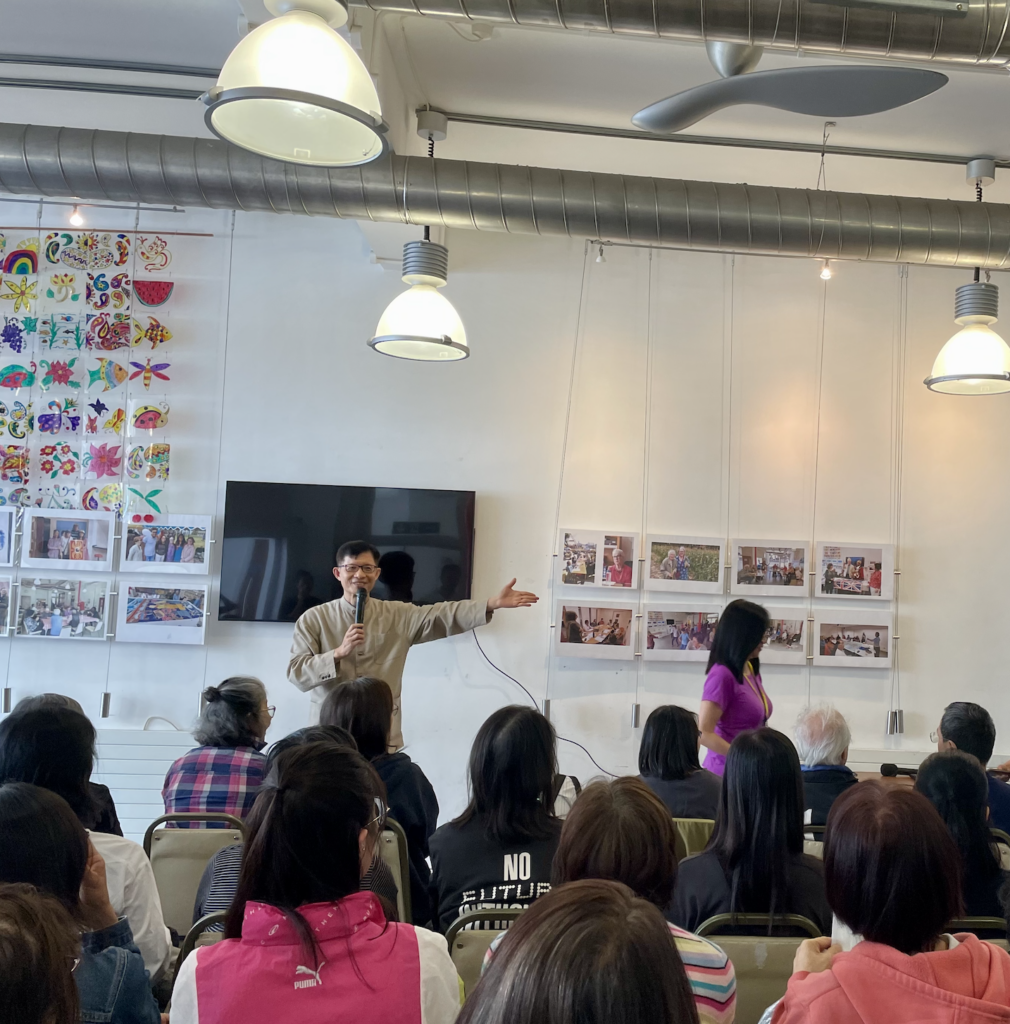
Dr. Wah Shan Chou, founder of DP and Mindful Coaching Transformation, held a series of emotional transformation workshops and academic talks in the U.K. and Canada in 2024, all free to the local Chinese community and drawing full houses. In this photo from his overseas tour, Dr. Chou explains to participants why it is important to step out of the “victim” role in the Karpman Drama Triangle. Photograph by author.
It might sound like victim-blaming to ask victims to “take responsibility for their lives,” but I have witnessed how this approach empowered individuals during my years following this charity. Tired of being pigeonholed as a powerless victim, Jo refused to join any survivors’ network and opted for a self-directed modality of healing; it was her defiance against the trite narrative of victimhood. Standing in the center of the stage during an inner child workshop at DP, Jo was gently guided by her coach to break free from her victim shackles: “Mum,” she said in front of her peers, her voice trembling, “your apathy hurt me deeply. I used to blame you. But I am grown up now. I am not going to keep punishing myself for your mistake. I am going to take responsibility for my life.” Her coach then asked her to honor her breakthrough by repeating an affirmation commonly used in the MCT program: “I was a victim of what happened to me. But these things don’t define me. It’s what I do about them that makes me who I am. We always have a choice. We have a choice over how we react.”
Did LY feel that he had a choice when he lit that bag of charcoal in his room? Could a timely check-in from his girlfriend after their argument have altered the course of events? Would he have survived if his marriage and career hadn’t faltered?
In the face of loss, humans look for accountability. These days, “depression” has become an increasingly acceptable explanation—allowing people to blame an illness and sparing them from having to blame the world or themselves. The thought that “it was no one’s fault” offers immense solace in situations too painful to untangle.
Still, Jo and other courageous coaches at DP refused to be reduced to a diagnosis. They looked underneath the iceberg. By taking responsibility for how they relate to their wounds—which are part but not the whole of them—they cease to be a case in the DSM-5-TR. They become, in the words of the DP mantra, “a ceaseless process of becoming.”
Postscript Reflection
This has been one of the most enjoyable pieces I’ve written in years. Writing in flash required me to shift from analytical writing to a more empathetic mode of storytelling—a skill anthropologists are expected to have, but rarely trained in. The process also affirmed David Graeber’s conviction that the value of ethnography is not to serve a theoretical point. Our task, he reminds us, is to leave behind vivid and textured accounts of social life that others can revisit and reinterpret over time.
This piece also made me rethink what an ethnographic book might look like in an age of smartphones, burnout, and shortened attention spans. How do we keep ethnography relevant? Instead of having six long chapters in a paperback, could we offer twenty flash ethnographies delivered via an app or podcast? Could flash ethnography become the herald of the next golden age of micro (non)fiction?
Loretta Lou is Assistant Professor of Anthropology at Durham University, whose work explores responsibility and regenerative practices that promote healing and wellbeing for both humans and the planet.
This essay is part of the series “Flashes of Responsibility: Craft, Ethics, and Impact in Global Health Ethnography,” co-edited by Liana Chase,* Marlee Tichenor,* and Sienna Craig.
*Chase and Tichenor are co-first editors of the series.
[i] Jo is a composite character, based on the real-life events drawn from multiple individuals—some I know personally, others whose stories were publicly shared on DP’s YouTube channel.