Vincanne Adams
This flash ethnography tries to capture the ambiguity of ethnographic responsibility, in a place’s ability to pull upon emotional sensibilities, or when the insight that I may have had it wrong, or that things have changed, weighed heavily and unseated my certainty of both place and purpose. The struggle for a modern Tibet, often positioned discursively opposed to an independent Tibet, was for me made clear, like a flash, around 2015. It was on my tenth or so visit to Lhasa but only my second visit to the opera theatre on the outskirts of Lhasa with a group of foreign and Tibetan scholars, one of whom is depicted here. The beauty and grandeur of the scenery, coupled with the clarity that a future under Chinese governance was acceptable to many Tibetans young and old, ignited competing sentiments carved over twenty years of intermittent research in Tibet.
Halfway up the sprawling entryway to the outdoor opera stage, out of breath, she paused, turned, and caught the Potala skyline from across the Kyichu River valley. Lhasa, place of gods, looked nothing like it had when we had both first lived here, her as a student, me as an ethnographer. It was very different, save for the Potala—once home to the Dalai Lama—on the small hill rising from the valley, looking as if it were trying to kiss the heavens from a sea of high-rise and emerging industrial turmoil.
I caught her eye. Her tears formed, alongside mine. We had both been coming here for decades, insider outsiders. It was hard to embrace the change.
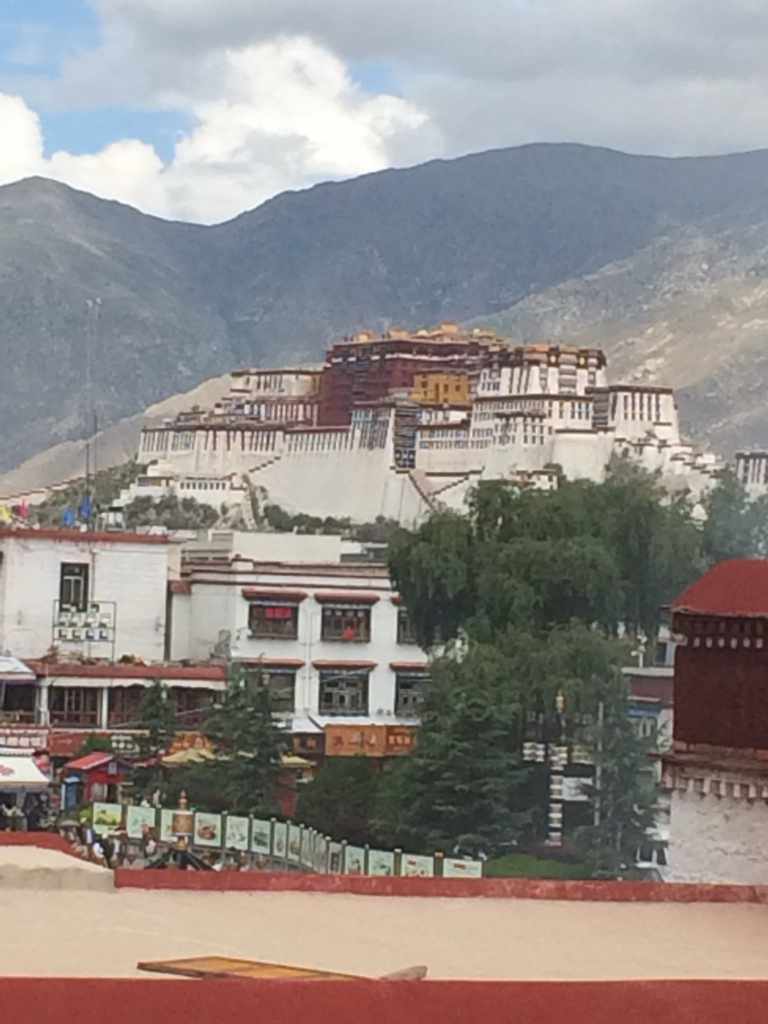
Potala. Photo by author.
We were going to see the contemporary opera, Princess Wencheng. It depicted the early eighth century arrival of this Chinese princess to marry Songtsen Gampo, Tibet’s first historic king. It was written by the famous Chinese lyricist, Zhang Minghe. His multimillion-dollar extravaganza included herds of live horses and yaks racing across a brightly lit hillside stage and a cast of thousands who, scene by scene, offered costumed folk dances, Buddhist recitations, even some traditional Tibetan opera with its piercing drumbeats, painted masks, and songs that could be mistaken for a band of frightened wolves. Tibetans thronged to watch Princess Wencheng. It was supertitled in Tibetan, Chinese, and English.
Foreign criticism of the opera as whitewashing the Chinese occupation of Tibet had not yet circulated when we bought our tickets. Still, it was not hard to notice that Wencheng mentions nothing about Songtsen Gampo’s first wife, who was from Nepal, or that depicting Buddhism’s arrival to Tibet as a gift from China ignores the many South Asian Buddhist teachers who made their way to the Plateau in the years before her. In Wencheng, Buddhism arrives to the barbarian hinterland as a moral civilizing accomplishment of the Chinese nation, as if China-the-nation (not just another warring kingdom) could have been imagined a millennium and a half ago.
I touched her shoulder and offered a sympathetic and presumptuous, “I know.”
Around us, people bustled toward the entry gates, middle-aged women in traditional long wool robes with colorful striped aprons, cardigans to match at least one color, and black hair tidily swept into a braid or bun. Younger Tibetans in jeans and puffy jackets, cell phones at the ready, knew they had time to grab a beer and dumplings with friends at one of the fancy restaurants along the palatial stairway. They seemed to relish the new cosmopolitan feeling of it all—an outdoor mall that rivalled others in Hong Kong and Shanghai, but on a great mountainside. The view of the Potala in the distance was still unrivalled. Like the UNESCO World Heritage sites in the city, this place also had bright streetlights, smooth paver stones, expensive storefronts, all of which looked old, but were actually new. The tourists came here for these, and for the crystal-clear air, not always cognizant of just how thin the oxygen was.
We didn’t need more words.
For two decades we had been silent witnesses. The furtive glances that said, “Don’t talk about that!” for fear that the secret police were listening. The sleepless nights, praying that we had done nothing to put our Tibetan colleagues at risk. The split-second recognition that an interlocutor’s prodding to speak openly about a relative who was still in jail or a monk who refused to sell his Buddhist scriptures as tourist trinkets were actually tells for a neighborhood secret policeman or even a rare kinsman hoping to cash in on political dissent.
I wasn’t sure if her tears were for the same reasons as mine. Mine were for the ongoing occupation and its silent terrors, the generations of Tibetans who had fled, been imprisoned, or burned themselves alive for independence but were nowhere to be seen here… or perhaps for the loss of that cause altogether. It felt like there, on the grand stairway to the monumental theatrical display, that politics had irretrievably shifted, and resistance had dissipated in the gradual slide toward material modernity that, in truth, many Tibetans longed for. There, it seemed that Princess Wencheng had won. This story of the merger between Chinese and Tibetan pasts was solidifying and creating a smooth acceptance of Tibet’s past as China’s too. Maybe I was reading it all wrong, relying too much on the metaphor of conflict when today’s politics were not so different from those of her time. She was, after all, a forced token of exchange meant to forge peace between warring kingdoms. Or maybe it was all just more complicated than I wanted it to be in my moment of grief over a sense of loss.
What was the loss I was grieving, then? Was it even mine to grieve?
We turned our backs to the Potala, letting our tears dissipate into the stiff upward tilt of lips signaling excitement over the spectacle of it all, making our way to the entry gates and being pulled along, arms interlocked, by the black buns and aprons and jeans and cell phones.
Postscript Reflection
The experiment of flash ethnography brought with it an invitation to reflect on what really matters in the ethnographic process. For me, there was a recognition of how the driver for determining what mattered in my encounters was clearly emotion in relation to responsibility. The challenge of writing emotional impact meant reflecting on an event so powerful it stayed with me as a lifelong memory, even if the event itself was at the time almost mundane. Using the flash form really worked to distill those commitments and challenges, thus achieving both attachment and surrender.
Vincanne Adams is Professor Emerita at UCSF Department of Humanities and Social Sciences, Joint Program in Medical Anthropology with UC Berkeley. She is the author of nine books on various topics concerning the Himalayas, critical global health, social theory, and contemporary public health disasters. She spent many years from 1993 to 2015 in Tibet working on projects related to Traditional Tibetan Medicine and women’s health.
This essay is part of the series “Flashes of Responsibility: Craft, Ethics, and Impact in Global Health Ethnography,” co-edited by Liana Chase,* Marlee Tichenor,* and Sienna Craig.
*Chase and Tichenor are co-first editors of the series.