Hannah Brown
This flash ethnography explores how ethnographic encounters can trouble one’s intentions for fieldwork. I describe an event that took place many years ago during fieldwork at the peak of the HIV/AIDS epidemic in rural Western Kenya. I ask what we ethnographers should do with these moments that will not leave us alone, that claw at us to think about them. The piece reflects on how inequities at the heart of ethnographic fieldwork can come to haunt us, what this might mean for thinking about care, and our obligations to those we encounter in the field.
Some things stay with you, like a haunting.
The three of us have been walking for some time. Let’s call my companions Judith and Atieno. They are middle-aged women with secondary school-aged children. Judith prefers her Anglo-Christian name; Atieno is a Luo name given to girls born at night. They both have some years of schooling, and we mostly speak English together, with a smattering of Luo and Swahili. They wear long skirts over thick petticoats and have covered their hair with scarves. I too am wearing a long skirt and a top that covers the skin on my shoulders. Women here take care to cover their bodies. Our walk has taken us past many homesteads, along winding paths that are not accessible by car. Judith carries a stick, picked up along the way, that she uses to beat down the grass to scare away snakes. Nowadays, Chinese-built motorcycle taxis run up and down these paths carrying people, their belongings, and items for sale, but back then motorcycles were expensive items. Even owning a bicycle was quite something. Like maybe for a teacher, or a nurse.
Eventually, we reach our destination. Immediately, it is clear that all is not well in this compound. Too many people bustle around. The tension is thick. A young woman is lying on a grass mat on the ground outside one of the smaller houses. She is too thin. She doesn’t speak, her arm wrapped over the top of her head for her to lean on. Sometimes, people relax in this position, seeking the shade against the sharpness of the midday sun and enjoying the quiet part of the day after the household chores and garden work is done. She is not relaxing.
I struggle to follow the conversation, and Atieno turns to me to interpret. The young woman is too sick, she’s been sick for a long time, the family have gathered to make plans to take her to hospital, they are trying to get the money they need, and to find someone who can take her there on the back of a bicycle. My heart goes out to all of them. This epidemic has been so cruel to everyone, but especially to young women, who often move long distances from home to live with their husband and his family when they get married. Then people get sick. Babies. Older children. A husband and one by one all his wives. People wondering what kind of jealousy or witchcraft could possibly be responsible for all this loss and suffering. Thoughts turning to the young woman, not long in the family, who is struggling to get along with her senior co-wife. And then, the cost. Repeated trips to hospital, expensive medicines, the person owning the bicycle wanting more money because the passenger is sick. Another woman giving up her own farming and domestic work to care for the person who is admitted to hospital. Sleeping on the hard stone floor under the hospital bed. People still suffer now, but during those days at the peak of the epidemic, before the medicines came, there were true horrors unfolding in the shadows of awareness across the rest of the world.
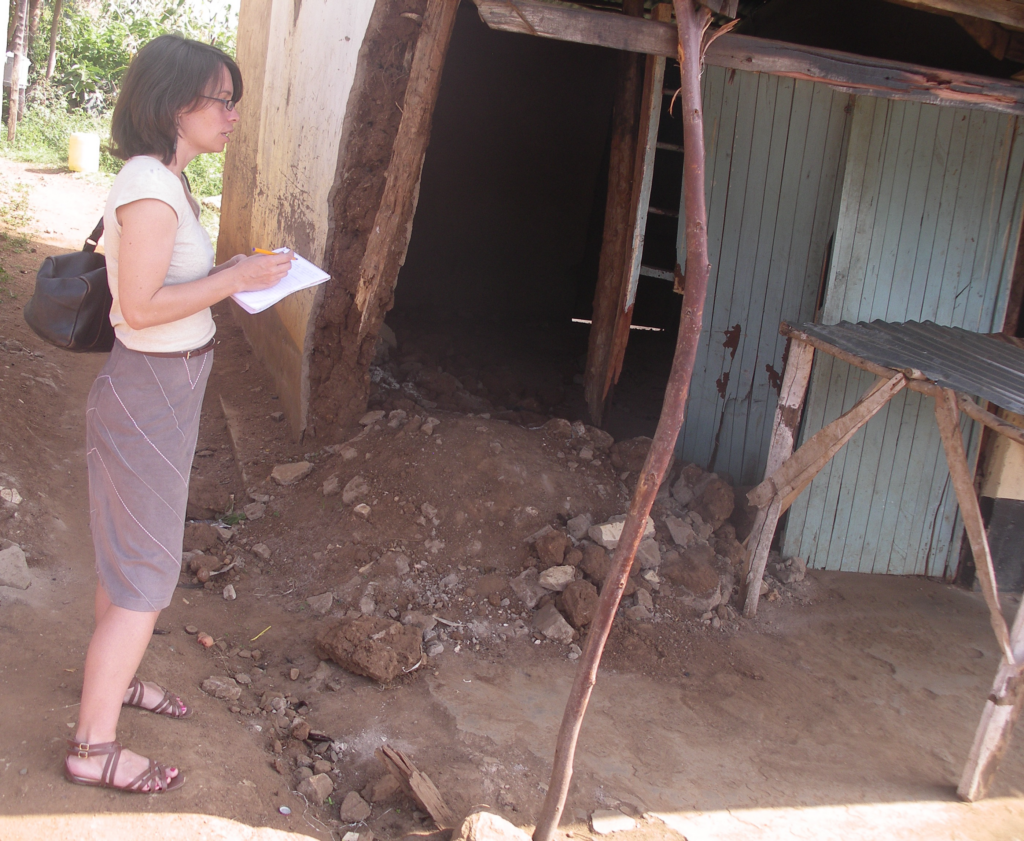
Hannah during fieldwork in Kenya in 2011. Photo courtesy of author.
It was too much. We were intruding. We made to leave politely, without even entering the house and greeting people properly. But then, something else happened. The haunting. Judith wanted to show me something. She walked over to the young woman, took the stick she had used to tamp down grass, and lifted her skirt high in the air. The young woman was naked underneath, and a slow and persistent trickle of thin diarrhea ran down her leg. “Tich tek,” Judith commented, in Luo. Perhaps she was thinking of the struggles of the woman’s family, her own work as an unpaid community health worker and the long distance we had walked, the endless labors of care that this cruel epidemic necessitated. Tich tek, hard work, indeed. But something else, more than this, too, in the gaze of the young woman lying on the mat. Her body remained immobile and acquiescent, but her eyes held fast to mine, determined, her stare loud and clear. Something else, too, in my shame and horror, about the uncomfortable power of Whiteness, and my unwanted right to tower over her sick and naked body, more than fifty years after the end of colonialism. Something about the ways that others can push us into positions that are not of our choosing, but which are nonetheless part of our world. And something about the weird and problematic pursuit of anthropology, and perhaps especially anthropology that is interested in asking questions about sickness, medicine, and the ways people care for others. The difficult territory of an endeavor that seeks to understand other people’s lives by asking them to open up to us.
Postscript Reflection
I am grateful to the organizers of the Flash Ethnography workshop in Durham in September 2023. I have always been convinced by the power of ethnographic writing to transport and transform, but the format gave me a new appreciation for the way ethnographic material can be made to talk for itself, without recourse to references, theory, or explanation. This has helped me to rethink the way I tell stories with my ethnography, and pushed me to attempt to say more, with less, in other kinds of ethnographic writing.
Hannah Brown is Professor of Anthropology at Durham University, U.K.
This essay is part of the series “Flashes of Responsibility: Craft, Ethics, and Impact in Global Health Ethnography,” co-edited by Liana Chase,* Marlee Tichenor,* and Sienna Craig.
*Chase and Tichenor are co-first editors of the series.