Ana Margarida Sousa Santos
This flash ethnography tries to capture the heavy, awkward silences that surround the experience of the anti-colonial wars in Portugal. The responsibilities of storytelling and inquiring into this painful past, and the avoidance that accompanies them, are central to discussions of the war. In considering how these silences can be productive, I draw on my research experience with war veterans in Mozambique and Portugal and ethnographic engagements with the politics of memory.
Silence. Painful. Awkward. Familiar. Angry. Loud. Resentful. Bored.
A man in his seventies rises from his chair. Shaking slightly, looking disheveled and unsure, he starts to speak of war and suffering. “I have something to say,”’ he said. “I was also there. I was not the same when I came back. I suffered and had no help from those who sent me.” His story, like thousands of others, echoes the experiences of many men of his generation. His experience and recollection of enduring pain is both singular and collective, familiar and distant. He doesn’t have to say much for us to recognize the story. Alongside nearly one million Portuguese young men, he was deployed in the mid-1960s for a tour of duty of almost three years in one of the war fronts in Portuguese-speaking Africa. Upon return to Portugal, his experience was silenced and unacknowledged.
He speaks softly, his voice hardly carrying in the small conference room. With the sadness comes an undercurrent of anger. He speaks of abandonment. At the same time, he recognizes that he was one of a limited number of men who was been able to access specialized medical care for post-traumatic stress disorder in Lisbon. For those who live far from large urban centers, such support had long been almost non-existent. His voice gets progressively stronger, and he looks intent on continuing his story, but he is asked to sit in silence and allow the rest of the day to proceed as planned. Shaking with anger, he tries to continue his intervention, but he is asked once more to be silent.
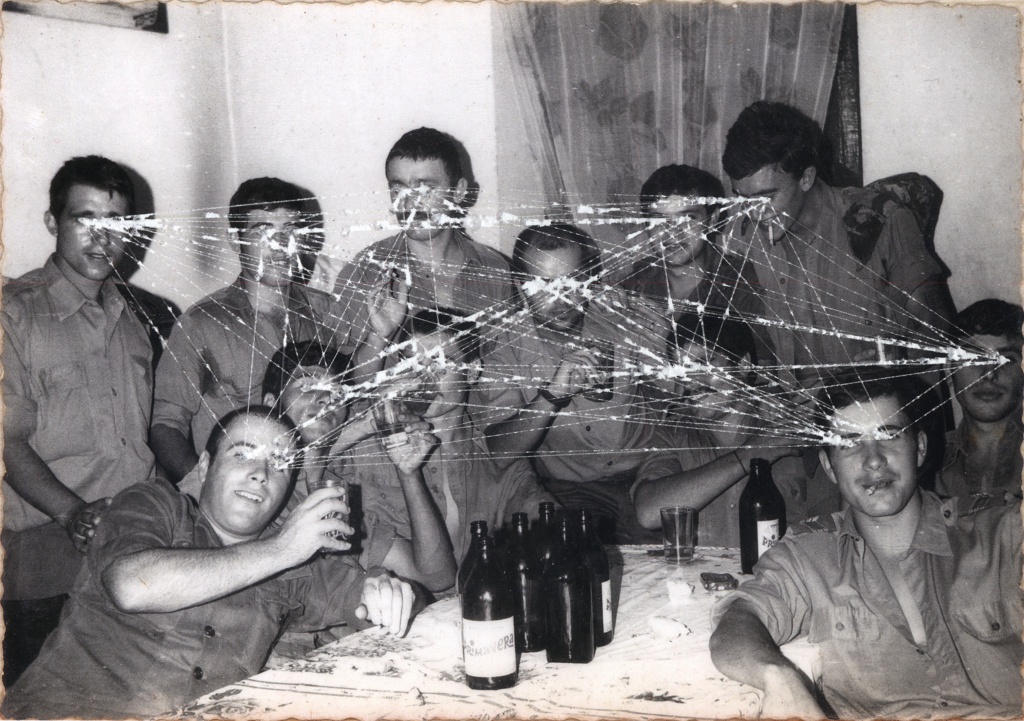
Daniel Barroca. Mapa de Cumplicidades #1 (Map of Complicities #1), 2011, inkjet print 100 x 140 cm. Courtesy of the author.
The ex-combatant’s outburst and the silence that follows it come after a presentation that opened the conference to commemorate the 25th anniversary of Apoiar, a small association that supports Portuguese ex-combatants from the colonial wars (1961-1974) suffering from combat stress. Just before the ex-combatant stood up to give his thwarted testimony, the founder of Apoiar, the psychiatrist Afonso de Albuquerque (1935-2022), described his own experience as a young conscript sent to fight in Angola at the onset of the war in 1961. Part of the first group of conscripts to a war that would mobilize nearly one million men, he focused on two moments: the arrival to Angola and his return to Portugal. He described in detail the training and the shock of arrival to an unfamiliar place to fight a war most of his fellow soldiers did not understand or agree with. Afonso’s reflection upon the return from war and the transformations that followed the Revolution of 1974 in Portugal, the process of decolonization, and the efforts to set up support for soldiers suffering from combat stress spurred the ex-combatant to speak. The day had been planned to highlight the work of the organization and the changes to care that ensued from their efforts. The conference directly and explicitly addressed the war experience and subsequent suffering of returning soldiers. However, even in such a setting, this personal account was unwelcome and awkwardly hushed. Personal narratives were a distraction. There was little space afforded them even in a space that could be conceivably understood as a privileged setting for the communal sharing of war-related suffering.
The rest of us sit there, briefly stunned, following his short attempt at telling his story. The awkward silence that follows is heavy with meaning. I look around. Other conference participants shift awkwardly in their seats, looking down, or through the windows into the sunny garden outside. None of us knows quite what to do. This is the usual response to unwanted, but not entirely unexpected, accounts of personal suffering and reminders of the many ways the wars linger on. We shouldn’t have been surprised. This is, after all, a familiar occurrence whenever the colonial war is discussed in Portugal. The anger surfaces, the long-buried pain along with it, forcing a reassessment of the past. The silences are familiar. Heavy, ghostly presences, loud and uncomfortable, they stand in for the years that are not spoken about. For the shame the colonial past and the wars elicit. For the pain. The unspoken and the half-words emerge in different contexts: an oblique reference after an episode of domestic violence, hushed discussions after a murder that captures public attention, the controversial and divisive representation of a homeless ex-combatant in sculpture in a small town, a moment at the bus stop or train, the rendering of suffering in a play, a novel, a film… Hardly ever directly confronted… Always heavy, always difficult… Interrupted, untold, silenced…
Postscript Reflection
The workshop where this piece first took form was my first encounter with flash ethnography as a way of writing. I was unsure how to approach the format and agonized over how best to write, if not on what to write. The open and supportive environment of the workshop and the process of reading the piece out loud (something I had not really done since my MPhil tutorials at Oxford) were extremely helpful in shaping this piece. These elements of the workshop helped me to focus on the silence and thwarted attempts to explore difficult pasts. The short but heavy moment I describe here was rewritten with feedback from the workshop in mind. It stands as one of multiple moments of ambiguity when engaging with the painful legacies of the anti-colonial wars in Portugal. The discussions during the workshop and afterwards led me to explore stylistic forms, imagery, and stories that can be told in few words but are no less meaningful than those that take more words to tell.
Ana Margarida Sousa Santos is Career Development Fellow in Social Medical Anthropology at Durham University and research associate at the Institute of Social Sciences – University of Lisbon. Ana’s research explores the politics of memory and legacies of violence. Her work in Cabo Delgado, Mozambique investigates the afterlives of violence, focusing on memory, belonging, and ownership. Ana’s current research with Portuguese ex-combatants examines the connections between silenced war memories, personal trauma, and collective remembrance of war.
This essay is part of the series “Flashes of Responsibility: Craft, Ethics, and Impact in Global Health Ethnography,” co-edited by Liana Chase,* Marlee Tichenor,* and Sienna Craig.
*Chase and Tichenor are co-first editors of the series.