Bo Kyeong Seo
Creating a new node of intellectual connections shifts the scale of conversation. The old divisions and hierarchies between local and global, domestic and international, native and foreign lose their force when diverse pathways open into a stream of thought that welcomes disruptive encounters. Announcing the formation of the East Asian Medical Anthropology Network(EAMAN) is delightful in this sense, since it marks an attempt to create a space in which various modes of doing medical anthropology can become known to one another.
The hope invested in creating a new network for medical anthropologists residing and working in Asia is that it can make unrealized lines of connection visible and open up new opportunities for collaboration and contestation. It is clear that Asia as a research site has played a significant role in the development of medical anthropology, as several discipline-defining canons are based on research conducted in Asia. Yet what has been lacking is sustained effort in approaching Asia as a site of conceptual and methodological innovation. What futures for medical anthropology emerge when Asia is taken seriously as a site of transformation and praxis? How does medical anthropology, in turn, matter in Asia? What significance has it brought to the region’s rich intellectual history and dynamic public discourses?
Preparing for and convening the first meeting under the banner of the East Asia Medical Anthropology Network (EAMAN) marked a pivotal moment for beginning to ask these questions and search for answers as a collective venture. This meeting was made possible in part through conversations initiated at the Medical Anthropology and Global Korean Studies Conference, held in Seoul in 2024 to mark the 10th anniversary of the Korean Society for Medical Anthropology. By learning more about the institutional development of medical anthropology in China, Japan, and Taiwan, and by confirming the shared willingness to sustain alliances, the plan to hold the network’s first meeting took shape. In this process, the Taiwan Medical Anthropology Society played a crucial role by generously offering space for the newly formed network within its annual meeting.
At this first joint conference in June 2025, two days of an intensive program created a lively atmosphere of exchange and discovery, revealing how key themes in the study of health and illness experiences have evolved along different directions. With both Chinese and English used for presentations, the gathering also offered an opportunity to glimpse how distinctive scholarly lineages have developed in Japan, South Korea, and Taiwan. The main theme of the conference was ‘super-aged society’ reflecting a major demographic shift now confirmed in both South Korea and Taiwan along the path that Japan already took. The common public health burdens that the demographic shift has brought to these neighboring countries were extensively discussed over the course of this two-day conference, but that’s not everything. What this event brought into view was the extent of innovative discussions and interventions unfolding across the region, many of which have been mostly circulate within national academic spheres. This small collection is intended to document segments of this larger gathering and use them as material to build shared memories of the conversations and identify openings for further inquiry and collaboration. Contributors to this series reflect varied levels of involvement in the network, from those who devoted several years to building the conference’s institutional foundation to a PhD researcher actively engaged in collaborative scholarship through this emerging transnational network. By providing their experiences of conference organization and panel discussions, all the contributors of this series offer an impressive sampler of medical anthropology here and now.
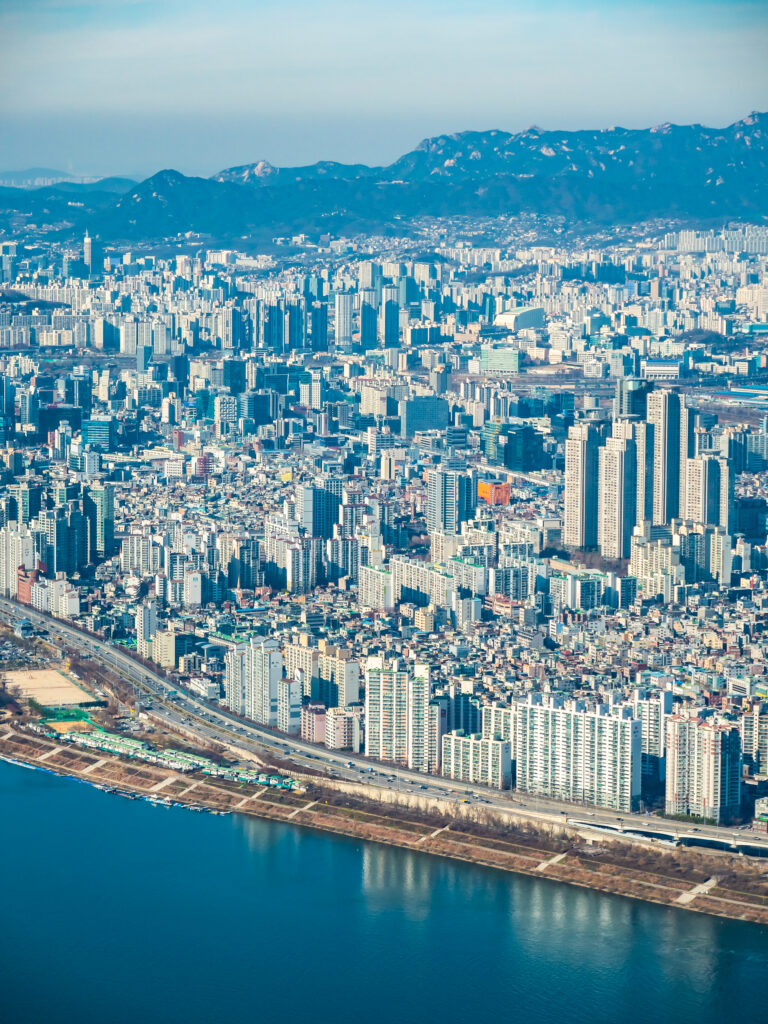
Seoul’s skyline, image credit: Freepik
Kwanwook Kim’s essay sets East Asia’s technology-driven industrial innovation as a central point for medical anthropological intervention. When Japan’s public and scholarly response to the detrimental effects of overwork, South Korean researchers’ long struggle to prove toxic exposure in Samsung’s semiconductor factories, anthropological focus on female call-center workers’ emotional labour, and Taiwan’s interdisciplinary scholarship on TSMC workers’ psychological distress and environmental toxicity are drawn together, an incredible synergy emerges for forging new alliances and solidarities. Inter-Asia connections require more rigorous intellectual investment because they are at the heart of technological innovation where capitalist accumulation changes its modalities through laboring bodies.
Minsu Yoo provides an interesting reflection on how developing a new kind of therapy entails multiple boundary crossings. By illuminating tensions that arise when psychedelic-assisted therapies are adopted in East Asian contexts, she introduces different affective landscapes: an advocate’s home, a leading clinic adopting the use of psychoactive substances, and conference spaces. Interests and disagreements around the efficacy of psychedelic treatments reveal how East Asian modernities have been shaped by historical projects that position biomedicine as a ‘scientific’ enterprise guaranteeing truth, alongside the creation of infrastructures that sustain biomedical rationalities. Eastern psychedelic movements are not the mirror image of their Western counterparts, but rather loci where multiple modes of knowing and global connections embedded within Asian modernities generate new friction.
In enabling transnational dialogues, which language is used matters. Although sinospheric legibility has enabled multiple forms of communication and understanding among conference participants, English remains the primary medium of communication. The first gathering for the new network confirmed that the question of how multiple linguistic practices might coexist needs to be more seriously discussed in the future. Despite such inadequacy, one key possibility that emerges from this gathering is that conference participants’ work of translation is not a simple extension of Anglophone knowledge-making project. Switching languages for communication is a forward-looking endeavor that opens new access to scholarship and activism that do not typically unfold in English. Even in an era when AI offers instant and smooth translation in digital spaces, creating a physical space where participants must switch languages in face-to-face communication, despite inevitable hesitations and improvisations, has proven incredibly joyful and productive in fostering mutual understanding and solidarity.
This possibility is well captured by Makoto Nish’s elaboration of Japanese scholars’ close engagement with the inter-relation between disability support and elderly care. Activists and practitioners’ testimonies and works on disability rights in Japan have a special position in East Asia, since they have become an important reference point for imagining and expanding the independent living movement in neighboring countries. In contrast, what is less well known is how Japanese medical anthropologists have been involved in this crucial legacy. By providing his personal memories of the sedimented impacts of a long struggle toward deinstitutionalization in Japan, he introduces a body of work that investigates how the value attached to independence and the socialization of care duties have encountered new challenges amid the combined effects of population aging and insurance restructuring.
Learning each other’s work and having meaningful engagement can only happen through sustained efforts to create a solid organizational ground for transnational encounters. Shao-hua Liu offers the brief history of how medical anthropology has gained traction in Taiwan along with her intellectual trajectory that has led her to acknowledge the crucial importance of inter-Asia communication and to actively shape this network. In anticipating future directions for this nascent network of medical anthropologists, perhaps it is important to note that this gathering has become possible through the female leadership and several people’s connective labor. This aspect also signals the hope that more feminist thought and feminist modes of engagement will further take root and flourish within the network.
Creating a shared thinking space is indeed a way of creating a space for discovery. With the formation of the East Asia Medical Anthropology Network, the conversation expected to emerge is not one that confirms existing regional divisions and national identities, but rather one that engages the contested geographical and racial formation of ‘Asia’ through medical anthropology. The network’s growth will also require a collective process of disrupting the hold of the discipline’s old habits and dominant infrastructure. Several interventions addressing medical anthropology’s historic whiteness and Euro- and US-centrism have shown that these traits persist unless alternative ways of diversifying centers and relating to each other’s work are actively cultivated. What is required is deliberate attention to distinctive intellectual genealogies, theoretical frameworks, and methodological commitments that have long gone unnoticed or been deemed less worthy. The people encountered through this network will bring different baggage, and their active exchange may open up a new square of intellectual connection and critical thinking.
Author Bio: Bo Kyeong Seo is Underwood Distinguished Professor in the Department of Cultural Anthropology at Yonsei University. Her research explores multiple dimensions of the politics of care in relation to medical infrastructure, populism, and queer struggles. She is the author of Eliciting Care: Health and Power in Northern Thailand (also translated into Korean as  (Whirling Days: Living with HIV in South Korea).