Liana Chase, Marlee Tichenor, and Sienna Craig
Liana Chase and Marlee Tichenor are co-first editors of the series and co-first authors of this introductory essay.
How can short-form ethnographic stories help us to understand the specter of responsibility in the anthropology of global health? Following other anthropologists who have experimented with flash ethnography, we have drawn on this practice as a method to contend with some of our field’s most perplexing theoretical and ethical questions. The authors represented in this collection are anthropologists working in the global health problem space. The workshop that brought us together at Durham University in September 2023 marked a moment when the terms and conditions of both ethnography and global health seemed to be changing rapidly, inspired by new theoretical stimulation from critical race theory and calls for decolonization, the rise of “critical global health” and its questioning of the very meaning of intervention, and the opening up of ethnographic form in ways that resist narrative closure and expand what counts as analysis.
Our flash ethnography prompt was to think with the concept of responsibility in global health by making our stories do the heavy lifting of social theory without the excess baggage of analytical passages. As both a form and a writerly practice, flash demands that we show, not tell. We each arrived at the workshop having written pieces of approximately 500 words, which were the first drafts of what we now share in this collection. We adhered to a workshop format that had been carefully crafted to build community alongside theory, with a spirit of generosity. The format was inspired by the work of Kathleen Stewart as adapted and refined by Sienna R. Craig and Laura Ogden, colleagues at Dartmouth who have developed a similar workshop as an annual tradition. The workshop format is designed to be generous and generative, bringing together scholars at different stages of their career to write, read, and think together. Over the course of two days, each of us read our text aloud, in full, to the group. Other participants then responded to each piece, drew conceptual connections between the pieces, and offered suggestions about continued writing and revision. Each morning and afternoon, we paused conversation to write alongside one another.
After the workshop, we each returned to our own pieces, honing first drafts into complete contributions of approximately 800 words. Beyond this word limit, we did not impose any restrictions on written form, recognizing that flash ethnographies may engage time (tense) and space (visual words on the page) in distinctive ways. As editors, our main role was encouraging authors to let go of extraneous words, explanations, interpretations to allow life-as-lived to speak more directly to the reader. The final texts are both more polished than their originals and more raw—holding space for the immediacy of experience.
What we discovered in the process of trying to craft stories about responsibility—ours to our interlocutors, our interlocutors’ to each other, institutions’ to our interlocutors, ours to our planet, and ours to ourselves and our loved ones—was that these stories were often pervaded by an affect of profound unease. In sitting with and writing through this unease together, we encountered a remarkable sense of movement. With so few opportunities in our field to reflect on the changing terrain both of global health and of morally invested anthropological research, we were tipsy with the freedom afforded by the tightly curated flash form. There was a sense of gratitude at the opportunity to reflect on the endless openings that these stories created even though we at times craved more nuance, thoroughness, and authorial voice. Together, we wrestled with what it might mean to trust the reader to draw their own conclusions.
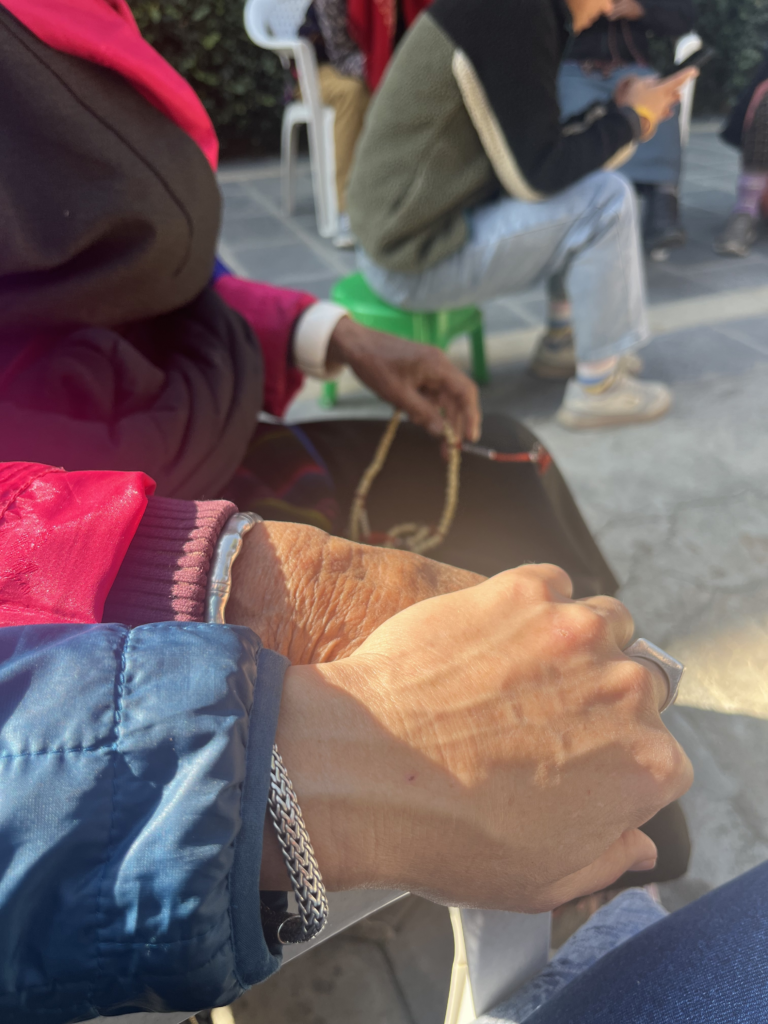
Sienna holds hands with an elder Mustangi while on pilgrimage. Photo c/o Sienna Craig.
In 2024, when we submitted this collection, questions about what constitutes responsible research in global health and in the anthropology of global health were at the forefront of all our minds (see Postscript for reflections on how the conversation has changed in 2025). Epistemic justice provoked us to ask: Whose truths are spoken, who can access the platforms to speak them, and who has access to the infrastructure needed to hear them? How can we reckon with lingering colonial dynamics while also honoring the increasing diversity of positionalities and perspectives within our fields? We are witnessing a growing awareness that producing anthropological knowledge about people’s lived experience of illness and health the world over requires new kinds of careful collaborations and inclusiveness, attention to broken and exclusive education, funding, and publication infrastructures, and perhaps most importantly, a constant practice of acknowledging the limits of our scholarly expertise and of making space so that others with different forms of expertise might fill it. The goal here is not to assuage our collective discomfort by naming these challenges; rather, our provocation with this collection is to engage with our unease as a source of epistemological insight that may point us toward unexpected and unruly ways forward.
The pieces in this collection approach responsibility from diverse social and interpretive vantage points. Still, there are clearly shared concerns and insights that emerge from the conversation among them. Some of the dilemmas of responsibility that ethnographers of global health confront today are far from new, reflecting a longer arc of engagement with inequitable distributions of human suffering in medical anthropology. Much thought has already been given to how the unique relationships we build as ethnographers entangle us in webs of reciprocity and obligation in communities over long periods of time, and many anthropologists before us have reflected on the ways that emotions and relationships in the field mediate our sense of moral responsibility. Yet, this collection also brings into relief shifts in the ground from which we navigate such dilemmas.
First, we see in this collection a complication of the lines between insider and outsider that calls for a thinking of responsibility in new directions. We see ethnographers connected to places not only through decades of research engagement and political allyship (Adams), but through ancestral ties (Shrestha), efforts to reckon political violence and intergenerational trauma (Uwizeye & Craig), family networks (Stevenson), and career trajectories (Tiv). This diversification of positionalities and relationalities within anthropology calls on us to move beyond long-standing assumptions about the producers and consumers of knowledge. At the same time, it demands ongoing vigilance about the ways inequities are reproduced within academic infrastructures. Taken together, these contributions reveal the need for more nuanced thinking on privilege and response-ability, or the uneven ways in which we are socially and structurally enabled to respond to the problems that confront us.
Next, many of the contributors in this collection push us to think about conflicting responsibilities—on our part as well as on the part of the interlocutors and institutions with whom we work—and the acrobatics of morality these conflicting responsibilities often demand. We see a continuity between anthropological and non-anthropological dilemmas of responsibility, recognizing that global health (Tiv)—and perhaps life (Jenkins)—always already unfolds in a space of competing priorities, incommensurable value systems, and high-stakes decisions. In some instances, the objectives of anthropological inquiry sit in uncomfortable tension with the cultivation of caring and careful relationships which are essential for the value and production of ethnographic knowledge (Brown, Chase, and Shrestha). Increasingly, conflicts of responsibility bring human and non-human interests into the same frame, the fragility of planetary ecosystems provincializing the concerns that once dominated anthropology’s moral deliberations (Bala).
Finally, as the field of global health becomes more genuinely interdisciplinary and self-reflexive, anthropologists find themselves thrust into positions of moral authority that carry new ethical and epistemological complexities. On one hand, anthropologists are part of the same networks of medical knowledge production that we study, so much so that the tensions and overlaps between these two entwined forms of knowledge production can bifurcate our sense of how to understand the world (Tiv). As such, we cannot remove ourselves from the extractivist frameworks that undergird these networks. On the other hand, we are at times asked or assumed to be the moral expert in the room and invited to leverage our expertise in ways that are meant to undercut these extractive practices and speak for those whose voices are unheard. This might include highlighting the silences around certain topics, like post-traumatic stress amongst veterans of colonial wars (Sousa-Santos) or the empowerment and burden of the responsibilization of mental health (Lou). Alongside these practices of making-visible, we are also at times interpellated as providers of essential moral knowledge (Tichenor) or as indispensable witnesses to human suffering (Brown)—witnessing in ways that sometimes continue to haunt us throughout our careers. Yet, we practice the same acrobatics of morality that our interlocutors do (Jenkins), and there can be no simple picture of the moral work that anthropology does. This collection asks how we might learn from this ambiguity, resisting the temptation to clear it away to achieve a neater, more comfortable account of our roles and our work.
How can anthropology respond to the shifting moral terrain of the present in ways that open dialogue rather than defaulting to defensiveness, virtue-signaling, or navel-gazing? This collection considers how the written form might help us feel our way forward. It captures the rise of polyvocal work within anthropology – coauthored (Uwizeye and Craig), “multi-sighted” (Chase and Shrestha), dialogical (this collection). But it also explores the affordances of the genre and method of flash ethnography. Perhaps paradoxically, we found that the confines of an 800-word contribution liberated us from other disciplinary demands that draw us away from our ethical and epistemological commitment to humility—the demand to formulate interpretations, to build arguments, to reconcile and resolve, to close. In flash ethnography, we were invited to write without reconciliation or the need to reach closure and move on, thereby doing justice to the unfinished quality of life as lived.
Postscript Reflection
As we finalize this collection in September 2025, the questions about responsibility it raises seem to have kaleidoscoped into new registers. The government of the UK, where our workshop was held, has recently announced plans to slash foreign aid funding in favor of more spending on defense. The situation is more dire in the country we call home: within a few months of the current American president’s inauguration, the US Administration for International Development (USAID) was dissolved, the funding for the US President’s Emergency Plan for AIDS Relief (PEPFAR) was frozen, and the US pulled its membership and its $1.28 billion annual investment from the World Health Organization, where it has been the largest donor for decades. Financial support for global health from the US dropped from $14.2 billion in 2024 to $4.76 billion in 2025. UNAIDS, among others, have warned about the unthinkable consequences of this dismantling of infrastructure and divestment in global health, noting that saving PEPFAR from DOGE’s maw did not save crucial community-based HIV/AIDS services in many places since they depended on USAID for implementation. It is hard to summarize the anxieties, the shock, the disbelief—and maybe, perhaps, deep down, the wild hope for revolution—these actions provoke in us as we consider the future of global health and of anthropology. What does responsibility mean in this rapidly changing world, where the unequal distribution of human suffering is no longer considered a matter of concern—or even the pretense thereof—by our governing officials? The foundation for the flash ethnographies gathered here seems to be eroding at a shocking pace. Just eight months into 2025, an ethnographic workshop reflecting on “responsibility” in any subdiscipline would produce entirely different interventions.
Liana Chase is a medical anthropologist at Durham University whose interests include global mental health, psychiatric humanitarianism, and emerging alternatives to conventional mental healthcare.
Marlee Tichenor is a medical anthropologist at the University of Edinburgh who teaches and writes about the impact of quantification in global governance, the production of global health knowledge, and our affective relationship with quantified data.
Sienna R. Craig is a cultural and medical anthropologist at Dartmouth College whose research and writing focus on migration and social change, Asian medicines, women’s and children’s health, and dynamics of kinship, aging, and care between the greater Himalayan region and North America.
This essay is part of the series “Flashes of Responsibility: Craft, Ethics, and Impact in Global Health Ethnography,” co-edited by Liana Chase,* Marlee Tichenor,* and Sienna Craig.
*Chase and Tichenor are co-first editors of the series.