Liana Chase
This piece relates an encounter with two women friends who have also at times been interlocutors or collaborators in my research on global mental health initiatives in Nepal. It reflects on the ethical complexity of doing fieldwork across gradients of power and privilege in communities affected by natural disaster and the mass loss that accompanies it. My doctoral fieldwork in this region began about one year after the devastating 2015 earthquake that claimed the lives of nearly 9,000 Nepalis. The interview described here took place seven years later in the context of a new and collaborative ethnographic project spearheaded by Parbati Shrestha. This piece was written in dialogue with Shrestha’s contribution to this collection.
The last stretch of the hike to Kabita’s home was the most strenuous.[i] The stone-lined footpath of the lower farmland gave way to a thin thread of tamped earth winding around rocky protrusions from a near vertical incline. Parbati and I stopped often to rest, sweat soaking through our shirts. It was the first time she had travelled this far up the mountain and the first time I had shared the anticipation of this journey with another anthropologist. We joked about growing older and fatter in the mixture of English and Nepali we had taken to speaking when we were alone together. There was a time, we reminisced, when I moved up and down this mountainside with ease in my black plastic flip flops, reveling in the hospitality afforded to me as a White American graduate student, while Parbati carried the weight of responsibility for coordinating the post-earthquake mental health program I had come to study. The long hike gave us the gift of hours to reflect on all that had changed between and around us in the seven years since, as well as all that had not.
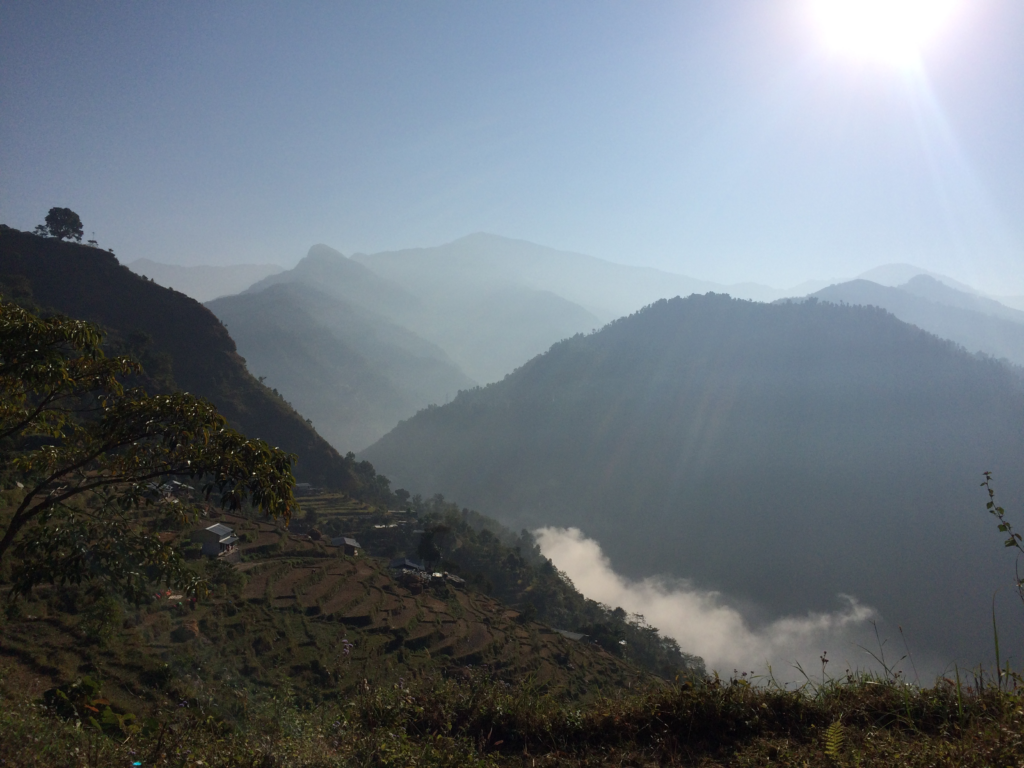
A view of the Himalayan Foothills, Nepal. Photo by author.
When we finally arrived at the small settlement where Kabita lived, the whole family was waiting. We were ushered into a simple brick-and-concrete home that I recognized as the hard-won accomplishment of years of painstaking post-disaster reconstruction. The ground-floor room was bare except for a gas stove and a small wooden table, where we were encouraged to sit and rest. In one deft motion, Kabita filled a glass to the brim with homemade millet liquor and placed it before me. Her daughter stirred a fragrant chicken dish bubbling on the stove, her own small child balanced on one hip. “Of course we needed to cook,” Kabita dismissed our protests, “when someone from so far away has remembered us.” I winced inwardly; here was the unearned capital that Parbati and I had found words for together, yet which continued to set us apart.
As we ate, Kabita and I talked. She told Parbati that I was like a daughter to her, having come into her life on the heels of the unthinkable losses she suffered in the 2015 earthquake. We made our way through memories—hiking to the roof of the mountain with relatives, the day-long journey to the village where she was born, a bumpy bus ride to meet a psychiatrist in the district headquarters. Each story affirmed and reinforced the threads of affection we had managed to knit across chasms of unjust difference. A complicated gratitude washed over me. What did it mean to cherish a relationship born of disaster ethnography? What were the coordinates of reciprocity in this uneven landscape, and how did time, friendship, and foreignness tip the scales?
I was well into my second glass of liquor by the time Parbati and I broached the subject of an interview for the new study we were co-leading. We explained that we were working to document the legacies of post-disaster mental health interventions, and to do this, we hoped to interview people who had been on the receiving end of such services. Kabita agreed to help us without hesitation, and we moved outside to the earthen porch that ran the length of her home. She unfurled a woven straw mat and we sat together, cross-legged, before a breathtaking panorama of the Himalayan foothills. The thin air sent a chill up my spine. As my rusty Nepali faltered, Parbati took the lead in guiding Kabita through the formalities of the interview process. A small crowd of neighbors and relatives gathered around us with curiosity, studying the information and consent sheets we had carried up the mountain in our backpacks, listening in.
Throughout the time I spent in Kabita’s village as a doctoral student seven years earlier, I instinctively avoided asking certain questions. As soon as our interview began, I regretted betraying this intuition of my younger self. It took just one question to thrust Kabita back into the grip of the worst moments of her life: Can you tell us what happened at the time of the earthquake? As she began to recount the excruciating details of the day, it dawned on me with a sudden and terrible clarity that there are some wounds that never heal. Panic rose up in my chest at the thought of having brought forth tears that held only pain, no relief.
I looked up, shamefaced, to see our crowd of onlookers swiftly dispersing into the surrounding fields and homes. As though echoing their silent reproval, my audio recorder failed to capture a single word of the interview that followed.
Postscript Reflection
Engaging with “responsibility” through the medium of flash ethnography has enriched my work in ways I never expected. More than a year after producing the first polished version of this piece, I continue to reap the benefits of our workshop discussions. Most strikingly, I find I have relaxed into greater humility in my thinking and writing. I am more inclined to acknowledge uncertainty, to allow unresolved tensions to linger, and to mark my conclusions out as tentative or unfinished. More concretely, I have been inspired to experiment further with flash ethnography as a mode of dialogical knowledge production. The book manuscript I am preparing for publication now includes six brilliant pieces of flash ethnography by Nepali mental health professionals and researchers. It has been an immense pleasure to share the joys and possibilities of ethnographic storytelling with colleagues working across disciplinary lines. The experience leaves me with a sense of the tremendous untapped potential of this genre to make anthropology more accessible, inclusive, and impactful.
Acknowledgments
This research was made possible by support from Dr. Serena Bindi’s “Phantoms or Fantasies” project funded by France’s Agence National de la Recherche and by research development funds from Durham University.
Liana Chase is a medical anthropologist at Durham University whose interests include global mental health, psychiatric humanitarianism, and emerging alternatives to conventional mental healthcare.
This essay is part of the series “Flashes of Responsibility: Craft, Ethics, and Impact in Global Health Ethnography,” co-edited by Liana Chase,* Marlee Tichenor,* and Sienna Craig.
*Chase and Tichenor are co-first editors of the series.
[i] Aspects of Kabita’s life have been altered and omitted to preserve anonymity.