Kwanwook Kim
The literal meaning of the Japanese term genba ( ) is a place where things are done at the present moment (
 ). While this term has a meaning similar to that of an anthropological field or fieldsite, it is also widely used in East Asian industrial spaces to denote a workplace: hyun-jang in Korean and
  in Chinese. Genba is everywhere and all different, but there is a common question often hidden in the shadow of hyper-industrial success: Why do hardworking people die at their workplaces? By approaching genba as not merely a physical space but a living knowledge site where the effects of work on workers’ bodies and the environment are negotiated through multiple languages and practices, we can better connect what is too often treated as separate in East Asia and find better answers to this pressing question. This lens surfaced sharply in the East Asian Medical Anthropology Network (EAMAN) session, “Workplace, Labor, and Mental Health in East Asia,” where placing Taiwan’s semiconductor sector, South Korea’s call center industry, and Japan’s long debate on karoshi (death by work) in one conversation made clear that worker health must be addressed beyond national borders, within a broader East Asian context of tightly entangled industries, supply chains, expert knowledge, and legal categories.
Bringing Together Different Fields in East Asia
Yi-Cheng Wu, a psychiatrist trained in Taiwan, presented on the psychological distress experienced by engineers at Taiwan Semiconductor Manufacturing Company (TSMC), the largest semiconductor foundry in the world. Observing the intense pressure cooker environment in Taiwan’s semiconductor sector, he consistently brought up the mental health crisis at TSMC, drawing regional parallels to South Korea’s struggle with “Samsung leukemia” and the subsequent civil movements like SHARPS (Supporters for the Health And Rights of People in the Semiconductor industry). Yi-Cheng paid close attention to corporate culture and “obedience,” often framed in Confucian terms, as a key feature of the workplace. This was also evident in his clinical encounters: some workers showed excellent compliance even with treatment, while others—despite having medical benefits—avoided seeking care to hide psychological difficulties. In his account, to work at TSMC one must be obedient, show servility, and possess personal resilience; he captured this with the provocative phrase “voluntary slavery?” This framing resonates with a broader discussion of Confucian-based corporate culture, while also sharpening a specifically workplace-based question: how does corporate discipline shape what workers can reveal, and what remains hidden, when distress emerges at the genba?
My Korean case entered through a different genba: the call center. I began with the film Next Sohee and news articles about suicide cases of female counselors in the Korean call center industry, describing the humiliating work environment that drove some counselors to suicide attempts and deaths. I pointed out how their suffering was repeatedly reduced to depression. My fieldwork suggested that this reduction was inadequate. They were not simply depressed, but oppressed, and the Korean term eok-ul ( ) conveys the sense of being wronged or unjustly treated; unlike the Taiwanese workers Yi-Cheng described, the Korean female counselors I observed—though also forced into a form of voluntary slavery—chose to resist by organizing labor unions to address injustice, and although their unions’ scale and tangible results were limited, their refusal to be slaves was unmistakable, making the workplace genba not only a site of suffering but also a site of contestation where moral injury and structural violence were named and politicized. At the same time, the Korean case revealed another kind of compliance among medical professionals: when counselors sought to locate psychological suffering in the work environment, psychiatrists did not actively intervene in the way that Japanese psychiatrists did in debates on karoshi and workplace depression; it was extremely difficult to find psychiatrists willing to “medically” testify to workers’ suffering, and companies easily dismissed worker depression as individual psychological vulnerability, so the absence of expert testimony became a structural condition of invisibility shaping what could be recognized as work-related harm. Japan entered this comparative picture through Junko Kitanaka’s in-depth ethnography on karoshi and depression in Japanese society and related occupational health discussions. As Korea also suffers from an endless cycle of overwork, depression, and widespread suicide, I realized that Japan had experienced these issues decades earlier. What surprised me was that Japanese psychiatrists, under the banner of “psychiatric science of work,” actively participated in the debate and worked to prove that worker depression and subsequent suicides were direct results of industrial accidents caused by the work environment. In contrast to the Korean pattern of easy individualization, the Japanese trajectory highlights how the same kinds of suffering can be made publicly legible—medically and legally—through the mobilization of expertise. The point is not that Japan “solved” overwork and suicide, but that the institutional pathway differs, and that difference shapes what becomes actionable at the genba.
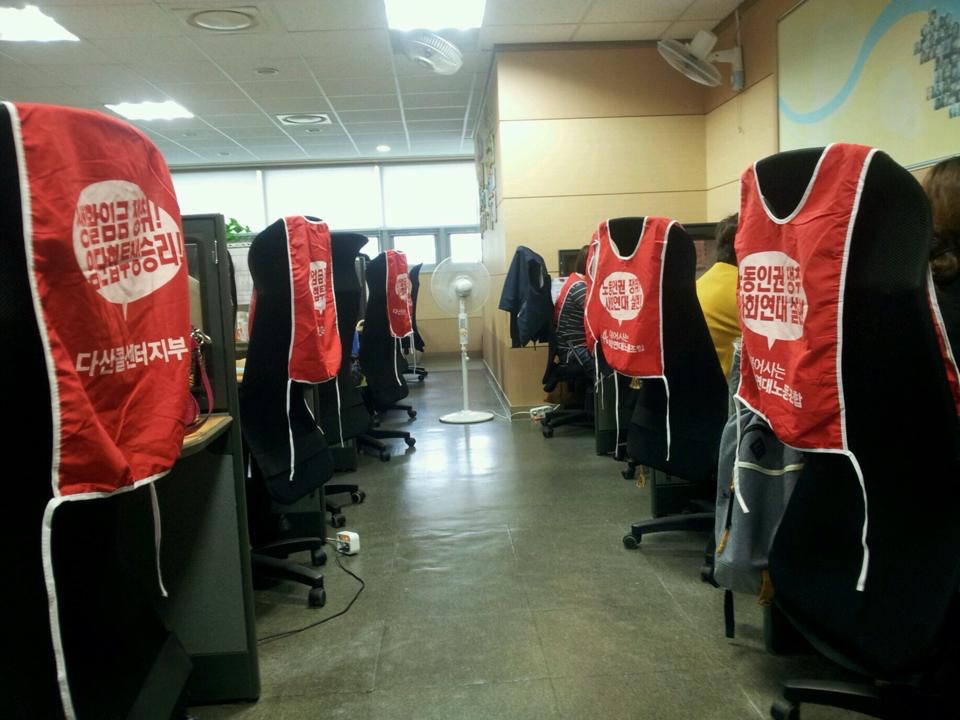
Expressing an Oppressed Feeling: A Counselor from Korea’s First Call Center Union Hanging a Protest Jacket, 2015. Photo courtesy of the Call Center Workers’ Union (Seoul, South Korea)]
The New Genba and Academic Responsibility
The session widened the frame beyond “stress” and “mental health” alone. The series of suicides among Chinese laborers at Foxconn, documented in Dying for an iPhone, together with similar issues facing female counselors in the Korean call center industry, show how harm can be routinized within the very logics of industrial success. Work in science and technology studies has demonstrated that contamination and exposure are not simply “found” but become visible through contested infrastructures of knowledge. Genba, then, is where invisibility is produced and maintained as much as where suffering is experienced. Chen Hsin-hsing’s Seeing the Unclean is instructive because it follows how environmental and industrial pollution becomes “seen” (or kept unseen) through institutional routines, scientific/administrative categories, and public disputes; read through the lens of genba, this is not a story outside the workplace but one in which the worksite, the surrounding environment, and the evidentiary practices that define “pollution” are co-produced, allowing “unclean” conditions to persist as a managed normality rather than an acknowledged emergency. Building on this insight, historian of science Lisa Onaga has explored how the relationship between toxic exposure and health emerged in Asian history through the concept of genba (reconstruction of the site), which clarifies why workplace fields must be treated as knowledge sites: genba is not only a site of pollution exposure or psychological distress but where interpretations, evidence, and responsibilities are negotiated across institutions, thereby making both the TSMC site in Taiwan and the Korean call center site places where labor is “visibly” displayed yet invisible knowledge and medical/legal controversies are continuously produced.
When the session ended, I sketched some graphs on my notepad, questioning why each field had a different trajectory for its genba. I examined how meaning about labor and health is produced in the medical, legal, political, and academic spheres. I noted that in Korea there has been strong political activity through labor unions; in Japan, there has been strong testimony from medical experts; and in Taiwan, while less politically active than Korea, there have been more testimonies from medical experts, including Yi-Cheng’s own work. I then showed the area that remained a question mark in my sketch: the academic sphere. As medical anthropologists and historians, what kind of academic debates have we contributed to in East Asia? None of us could confidently answer this for our respective countries.
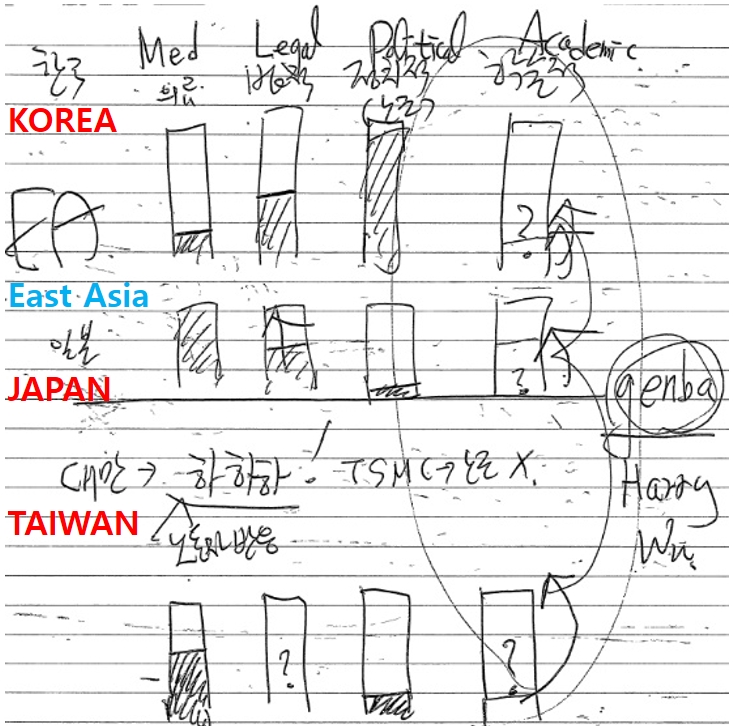
A Sketch of Different Workplace Genba in East Asia, Image credited to author
This question mark should not be treated as a minor gap. In my research, the new introduction of AI in the Korean call center industry is causing unexpected labor distress, which I termed techno-moral distress. As of today, we have yet to see sustained academic discussion on this topic, while a new socio-technical imaginary around AI is emerging. This matters because AI can reorganize what counts as “evidence” and what becomes visible in workplaces—potentially rendering workers’ health issues, which have not been properly made visible until now, invisible again. Broader debates on how technology reorganizes social life and responsibility make this point explicit: visibility is not merely descriptive but politically consequential.
Conclusion: Reconnecting Existing genba
Finding “new genba” does not only mean identifying new workplace sites; it also means linking existing sites—semiconductor cleanrooms, call-center floors, clinical offices, compensation boards, and policy arenas—by tracing how harm travels across industries, disciplines, and jurisdictions, and this East Asian comparative approach has concrete advantages: it clarifies legal similarities and divergences in how work-related harm is recognized (or denied) as industrial injury; it makes visible industrial connectivity in tightly coupled ecologies—supply chains, subcontracting structures, platformized management—through which risks and responsibilities are redistributed; and it reveals recurring patterns in medical response, whether distress is individualized as vulnerability, collectivized as injustice, or transformed into actionable injury through expert testimony. If there was one certainty we gained from the session, it was our responsibility to address the academic question mark as part of this reconnection by identifying the scenarios that bring environmental, occupational, and health-related problems to the surface and mapping the actors within them—medical institutions, legal forums, labor organizations, and policy actors—so that an East Asian network of scholars can expand its influence across medical, legal, and political spheres, not as isolated commentators but as a collective academic genba that stabilizes shared vocabularies, comparative evidence, and public responsibilities.
Author bio: Kwanwook Kim, M.D., Ph.D., is an Assistant Professor in the Department of Cultural Anthropology at Duksung Women’s University, Seoul, South Korea. Trained in both anthropology and medicine, he serves as President of the Korean Society for Medical Anthropology. His research examines how structural violence, labour, and technology shape health in Korea—covering call-center emotional labor, migrant health, smoking and addiction, post-disaster mourning, cancer screening, state violence, and illness among North Korean defectors, with recent work on AI’s impact on work and health.