Parbati Shrestha
This piece of flash ethnography is based on a visit to a research participant, together with Dr. Liana Chase, a friend who is an anthropologist like me, but a foreigner. The visit evoked feelings of being both an outsider and an insider while travelling to the hills and mountains in Nepal near my family’s home village. This reflection aims to explore the ethical dilemmas inherent in conducting research on mental health in post-disaster settings when a participant shares a painful story.
The towering mountains that loomed in my memory from childhood journeys home were now in front of us. This scene used to captivate us all when we travelled from Kathmandu to the village for major festivals, leading us to ponder the challenges of life in remote areas. This trip with one of my foreign friends was planned to meet lay counselors and follow up with one of the service users of post-earthquake psychosocial support. To travel with a bideshi, a foreigner with white skin, was very attention-grabbing to any Nepali, as I found myself experiencing along the way. People treated me in a special way, and I noticed wandering eyes watching both of us on our journey. We were traveling to a hilly area where my colleague had conducted fieldwork in the past, and I was interested to learn more through joint fieldwork with my experienced academic friend.
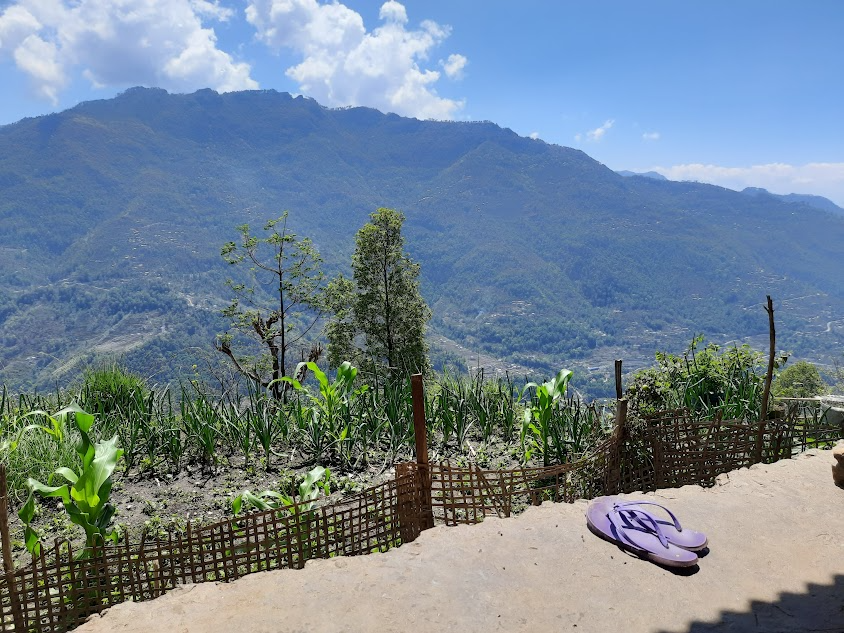
I randomly took this photo during the trip and later realized how much it reflects my thoughts on responsibility and empathy. No one truly knows the burden a pair of slippers has carried; the most we can do is remain authentic, responsible, and humble in our work.
I discovered that my friend’s host father was my mit mama, a unique connection established between two individuals of the same gender, sharing equal status in both families, and marked by mutual respect. While this is a special relationship, my friend had an even more profound bond with that family. She was like their daughter; she knew all their family dynamics, including the nuances of their relationships, and business affairs. I saw how she was treated with distinction by the family, how the entire village accorded her a special status. I wondered if it would be the same for a Nepali scholar who came to visit that place with the same objectives, if it might take more effort to get the same attention. I remembered how much I had had to use my networks and relations to find participants for my own anthropological research, and how much effort it took to convince people to participate. Even when participants consented to interviews, I felt that they hardly trusted me.
On the long walk uphill to meet “Aunty,” the psychosocial service user we hoped to interview, my friend and I discussed our differing relationships to our participants:
Parbati Shrestha (PS): I am so surprised to see how people are reacting and seem interested to know about you.
Liana Chase (LC): Yeah, they were so kind and helpful to me when I was student, and there is nothing I can give in return. Would it be different if there was a Nepali scholar in my place?
PS: Definitely, there would be vast differences. They trust foreigners more than Nepali scholars. People think that you have the power to bring social changes and can link them with resources.
LC: I am so afraid that I am raising expectations too and I think I am not alone. Lots of scholars have the same feeling that they could not contribute to their host community after they go back to their own world.
PS: I think that’s why they search for some opportunities to pay back when there are major calamities like the experience during the earthquake. People in academia also tried to help their host communities to come out of the earthquake.
LC: Yeah, that’s true. Maybe they search for an opportunity to pay back their gratitude, as they learnt from Nepali culture too in different forms, so that they can feel some sense of satisfaction.
PS: Yeah, this may be the responsibility towards your host who had helped you when you were in the journey of knowledge-making, and their contribution needs to be well acknowledged too.
We arrived at Aunty’s home and began talking over food and drink. We were offered more food than we could possibly consume, to our host’s delight. However, the ambiance shifted when we began the interview. We realized that our inquiries had probed a wound still in the process of healing.
Aunty freely shared her tears with us, but what was our reaction? Were we truly doing good, offering support, or perhaps unintentionally causing harm? What was our responsibility here, now? To whom?
We endeavored to listen empathetically and provide support without further intrusion or judgment. Yet, doubts lingered—was our approach sufficient? Should we consider contributing to her regular expenses for medicine, a therapeutic aid to cope with the haunting incident she had recounted? What of the snacks, the drinks? Did she feel pressured to offer these to us?
Despite Aunty’s wholehearted hospitality, we grappled with the concept of reciprocity. Could we truly return her kindness? Would we be as accommodating if someone sought to study our lives? Would she exhibit similar warmth if another Nepali scholar had visited, without my foreign friend, and would her family reciprocate in kind? After the interview, Aunty implored us to stay, yet we made the decision to leave as we need to walk back to our destination, bidding farewell to her entire family.
We walked down the hill. The setting sun cast a contemplative glow. Memories of the time spent together were interwoven with a sense of guilt, and a multitude of unanswered questions.
Postscript Reflection
This is my first time using flash ethnography as a writing style. As a newcomer to academia, I have found that this method suits my way of writing. It offers a simple yet powerful way to communicate complex ideas, immersing readers in the environment, context, and setting. Though brief, it can convey a complete picture. In today’s world, in which attention spans are limited, flash ethnography can be an effective method for communicating anthropological findings. It also allows the writer greater creative freedom while staying true to the essence of ethnography.
While writing this, it felt like lightening a burden, as if a weight had been lifted off my shoulders, and at the same time it was therapeutic. I still carry some memories of that visit, along with feelings of gratitude toward our participants, who knew they would receive nothing in return, yet welcomed us wholeheartedly. Their innocence, vulnerability, and openness motivate us to be more authentic and responsible toward them.
Parbati Shrestha is student of anthropology and working in the field of mental health and psychosocial support in an organization called Transcultural Psychosocial Organization (TPO) Nepal.
This essay is part of the series “Flashes of Responsibility: Craft, Ethics, and Impact in Global Health Ethnography,” co-edited by Liana Chase,* Marlee Tichenor,* and Sienna Craig.
*Chase and Tichenor are co-first editors of the series.