Jack Jenkins
As a White European researcher studying bushmeat-related livelihoods in Sierra Leone, I initially faced challenges gaining access to markets due to traders’ mistrust of outsiders, rooted in their vulnerability to harassment by actors responsible for enforcing wildlife laws and public health regulations. Their desire to protect the precarious livelihoods on which they depend is understandable. While access to some other markets remained difficult over the course of my research, I was aided in my initial entry to the market described below, having previously accompanied youths from some of the traders’ home villages as they participated in strenuous group hunting activities in the forest.
Through my afternoons spent in the market in 2022, I developed a deep appreciation for the traders’ resilience and the difficult choices they face in providing for their families while balancing public health concerns and legal obligations. As an outsider studying these issues without personally facing the same acute pressures and consequences, I had to confront my own positionality and the limitations of my understanding. This essay emerged from a desire to shed light on the traders’ experiences and to reflect on the nature of responsibility amidst competing demands and difficult personal circumstances.
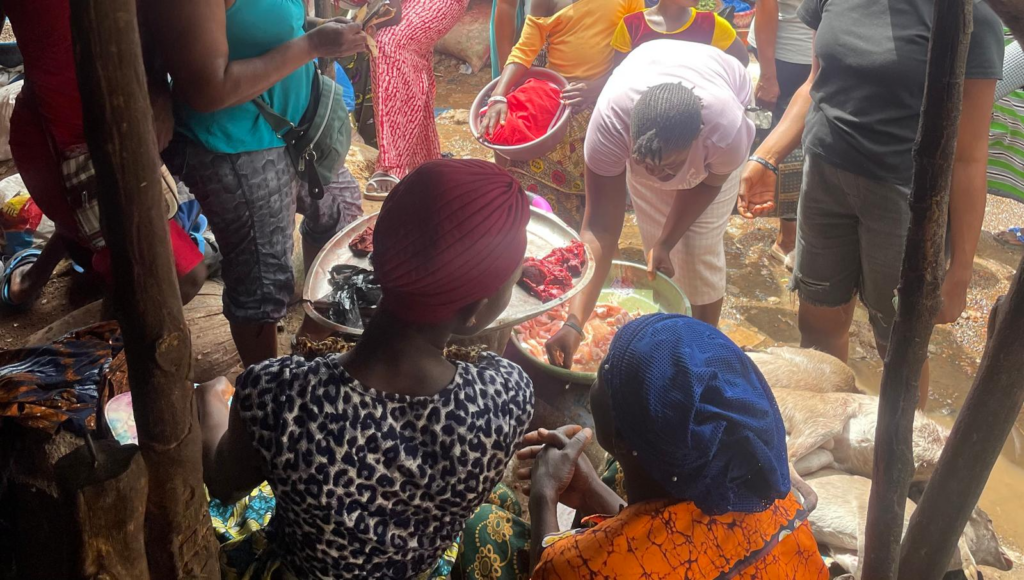
I watch as a young woman raises an axe above her head and brings it down at speed, cutting through the bone of the bush pig laid out on a butcher’s block. The sound of the axe’s contact with bone is masked by the cacophony of pre-recorded advertisements that most traders play on repeat through plastic megaphones. These intermingle with the shouts of traders and motorbike horns, creating a raucous soundtrack that matches the energy of the bustling marketplace. Bushmeat traders sit on wooden benches underneath the market shelter, facing outwards to watch whether the passing marketgoers will stop to negotiate a sale. At the front of the shelter, the meat of the animals I have watched being butchered over the past few hours is displayed to potential purchasers on large metal platters that rest on upturned wooden mortars. As new meat is added, it is swarmed by large green flies. Occasionally the traders attempt to swat them away, but this is a losing battle.
Traders sitting under the shelter and looking outwards to potential customers. Photo by author.
The shelter’s corrugated metal roof acts like a radiator in the afternoon sun. I sweat profusely. Fatima sits across from me and watches with a strained expression as her niece now uses a long knife to slice the bush pig’s flesh into portions. She explains that she arranged to buy the animal from a hunter over the phone that morning, but its arrival was delayed. The ongoing fuel crisis means fewer motorcycle taxis are operating, especially in rural areas. Car taxis are infrequently available and do not leave until every space for passengers and their goods is taken. After spending hours under the sun on a car taxi’s roof, the carcass had already begun to spoil by the time it reached Fatima. The air underneath the shelter is thick with decay.
As the afternoon wears on, the shadows of passing marketgoers lengthen. Time is running out for Fatima and her bush pig. Together with her fellow traders, she attempts to formulate a plan to recoup the hefty fee paid for the animal. They suggest she could preserve or mask the condition of the meat by smoking it or steaming it, affording her another opportunity to sell it tomorrow. I quietly wonder whether it is responsible to sell spoiled meat to the public, but I know from earlier conversations with Fatima where her primary responsibilities lay: “We are mostly single mothers, and we are facing a lot of constraints here. It is difficult to get money to take care of our children.” She wonders aloud, “How can I afford to lose such a sum of money? 1.3 million Leones!”I calculate that she stands to lose the equivalent of more than 80 US dollars. Not a sum that many people would easily forfeit in Sierra Leone. Fuel prices have already squeezed the traders’ profits and the plummeting value of the national currency is making daily essentials increasingly expensive.
Under the law, her obligations as a trader are clear. In a recent meeting with Health and Sanitation officials, I heard about traders’ responsibilities to abide by public health ordinances. Fatima knows some of these: “The government says that we have to protect the meat from flies, that we should cover the meat with [a] mosquito net. We should also use hand gloves.” From my conversation with the health officials, it was less clear with which authority responsibility for enforcing these regulations lays: “[Our] own work or our mandate is to [focus on] food animals … livestock, not wild animals.” Oversight of bushmeat markets is mainly the responsibility of other institutions and stakeholders including the city council, law enforcement, and local chiefs. Overall, it is much weaker than oversight of the city’s main markets, where domesticated meat is sold. When I ask about regulation, Fatima is not concerned with her legal duties or the risk of enforcement action. She tells me that if the “sanitation people” come to cause problems, she will just bribe them to allow her to continue selling her meat. This is the usual way of things. I depart late in the afternoon. The sanitation people haven’t come but a plan has not been decided about what to do with the bush pig either.
I return a week or so later and enquire about the fate of the bush pig. I learn that Fatima gave the meat on credit to a connection who prepares and sells bushmeat pepper soup to the public. Rather than losing her investment, Fatima had managed to turn a profit of 200,000 Leones. I congratulate her and take a seat on one of the benches. As I sit, my mind turns to the complex web of responsibilities at play: responsibilities to the public, responsibilities under the law, and responsibilities to family. What does it mean to be responsible when these varied obligations seem to pull in opposing directions? How does one weigh potential risks to consumers against very real risks of personal financial peril? In Fatima’s position, would my own actions have been any different? The questions linger, unresolved, as the market swirls with activity around us. I find myself hoping that, for the sake of the consumers, the batch of pepper soup in question somehow imbued its famous health-giving, restorative qualities to Fatima’s bush pig.
Postscript Reflection
When I wrote the first draft of this piece, flash ethnography was completely new to me. It was initially difficult to contend with a limited word limit in which I had to introduce a place, the people who work there, their pressing daily responsibilities, and potential public health impacts of their activities. Focusing on just two afternoons helped to cut down my scope into one coherent flash piece. Writing this piece significantly impacted my writing process. I now sometimes write flash pieces while taking notes in the field, and incorporate this type of writing in my work much more frequently.
The experience also impacted how I view my own responsibilities to my research participants. The collection’s theme encouraged me to reflect on my relationship to the traders’ concerns when my main responsibilities lay thousands of miles away. Publications based on my time in the market had ticked some of my own academic boxes, but can we ever guarantee that our work will produce tangible impact for participants when decision-making responsibility ultimately rests in the hands of others? I have returned to the market twice, each time bearing portable hand-washing facilities and antibacterial soap in an attempt to improve hygiene within my own means, having realized that publications likely won’t produce change in one small informal market. What responsibilities do we have to produce what limited change we can when participants and the public continue to face risks to their health while balancing acute personal challenges?
Jack Jenkins is a Postdoctoral Research Associate in the Department of Anthropology at Durham University with a background in International Development. Through his research, he aims to contribute to interdisciplinary understandings of the complex relationships between transport, mobility, livelihoods, and development in sub-Saharan Africa.
This essay is part of the series “Flashes of Responsibility: Craft, Ethics, and Impact in Global Health Ethnography,” co-edited by Liana Chase,* Marlee Tichenor,* and Sienna Craig.
*Chase and Tichenor are co-first editors of the series.