Shao-hua Liu
Back in 2014, at an academic gathering in China, a tall male anthropologist reacted with surprise upon meeting me. “Ah! Liu Shao-hua is so petite. How could you have managed such tough fieldwork?” This was a common reaction to my 2011 ethnography, Passage to Manhood: Youth Migration, Heroin, and AIDS in Southwest China. Years later, in 2019, when I posted a photo of the inauguration of the Taiwan Society for Medical Anthropology (TSMA)—where I served as Founding President—a colleague commented, “What an achievement for a petite giant!”
Although lighthearted, these encounters reminded me that perhaps many still do not expect a woman of my stature to take on gritty challenges. Despite Taiwan’s liberal climate regarding gender and sexuality, persistent stereotypes remain. Female scholars still find it harder to take the lead in establishing academic associations or spearheading challenging research initiatives.
Historically, Asian women in medical anthropology have gravitated toward “soft” topics like traditional medicine or experience-near phenomena of reproduction. However, I cannot help but stress that few Asian men have transcended “soft” topics either. This suggests that beyond gender bias, what defines our trajectories is the conceptualization of scholarship itself—specifically its relationship to lived experience, mirroring the imperatives of public anthropology.
My own path was shaped by such lived experience. Before becoming an anthropologist, I had long been exposed to the world’s complexities as both a journalist and an international development worker. This journey perhaps freed me from the preconceived limits, once prevalent in Asia, on how a female anthropologist could engage with cruel realities. Consequently, I have been able to carry out ethnographic research on subjects as arduous and sensitive as heroin, HIV, leprosy (Hansen’s disease), and policy failures in China, as well as controversial COVID-19 politics in Taiwan.
By reflecting upon these personal experiences, my goal is to highlight the long evolution toward founding the TSMA and its pivotal role in fostering the East Asian Medical Anthropology Network (EAMAN).
The Unfolding of Medical Anthropology in Taiwan
Taiwan has played a distinct role in shaping medical anthropology in East Asia. The field’s roots date back to Professor Li Yih-yuan (1931–2017), who pioneered studies on ritual healing, and well-being amidst Taiwan’s rapid social transformation beginning in the late 1950s. In the 1970s, Li’s perspectives deeply influenced Arthur Kleinman, whose seminal 1980 ethnography of Taipei, Patients and Healers in the Context of Culture: An Exploration of the Borderland between Anthropology, Medicine, and Psychiatry, subsequently inspired successive cohorts of local scholars.
Throughout the late 20th century, the field in Taiwan expanded incrementally, primarily centering on documenting local traditions of body and healing. However, globalization triggered a critical reorientation. A younger cohort of Taiwanese medical anthropologists—many of whom, including myself, were trained in the United States—began addressing urgent social issues at the intersection of public health and biomedicine. Local culture and healing rituals are no longer the ultimate ends of research, but analytical lenses to interrogate political economy, biopolitics, and science and technology studies (STS) (Adapted from my 2022 work on the development of medical anthropology in Taiwan.).
Despite this development, there was scant exchange with other health scholars, and the field remained marginalized in the entire discipline. Driven by a sense of responsibility, I initiated the Medical Anthropology Research Group at Academia Sinica in 2010, working alongside colleagues from various universities and hospitals. Over time, the growing demand for medical anthropological perspectives—from academia, clinical practice, and the public—outpaced the capacity of a circumscribed research group. In 2019, the TSMA was founded by a collective of medical anthropologists, physicians, and interdisciplinary scholars committed to these emergent approaches.
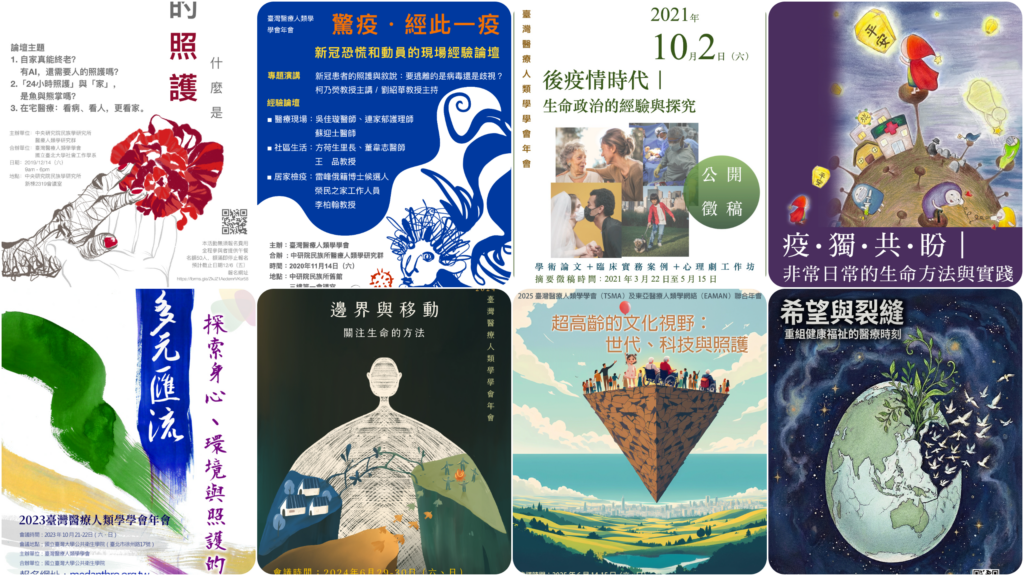
Posters of TSMA Annual Meetings
As fate would have it, our launch coincided with the COVID-19 pandemic. Yet, through sustained efforts to engage with pandemic issues, this crisis proved to be a defining moment. It demonstrated that medical anthropology provides a vital lens for understanding the pervasive impact of health on social life. By 2021, we adopted an open “Call for Papers” format, transforming our annual meeting into a vibrant local hub that, by 2023, had begun to attract scholars from across East Asia. The 2024 TSMA Annual Meeting, featuring Arthur Kleinman’s keynote, “Lessons Learned from the Ethnography of Caregiving,” further stimulated regional interest.
.png)

Forming the East Asian Medical Anthropology Network
In 2025, Taiwan hosted over 200 medical anthropologists and interdisciplinary scholars for the inaugural meeting of the East Asian Medical Anthropology Network (EAMAN), held in tandem with the 7th Annual Meeting of the TSMA. This joint conference, themed “Cultural Perspectives on Super-Aged Societies: Generations, Technology, and Care,” formalized regional exchange.
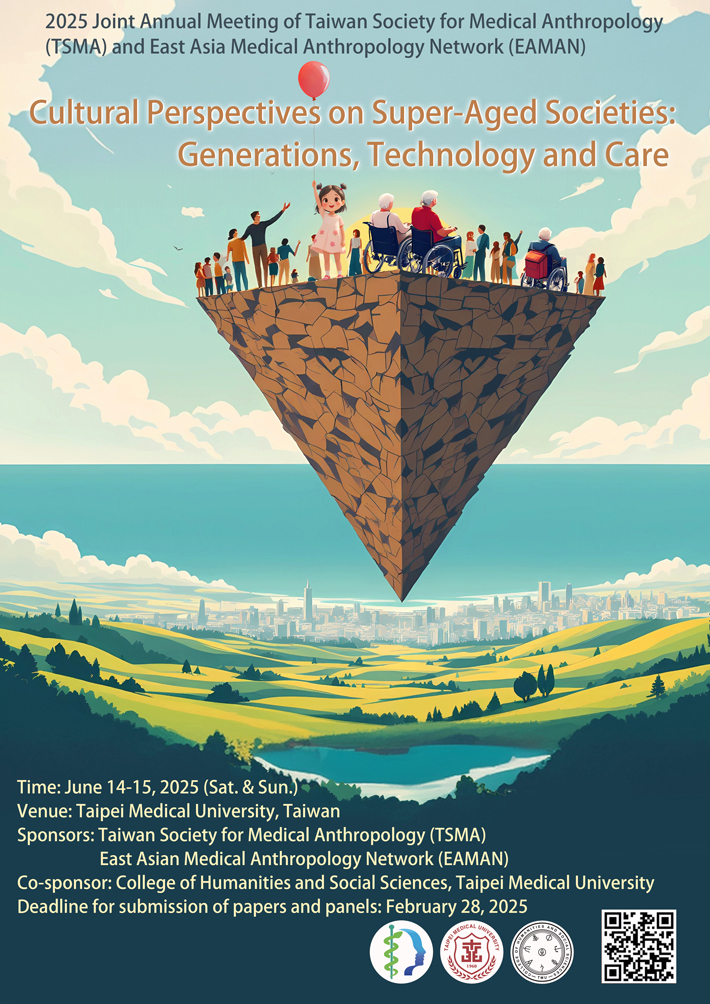
Poster of 2025 Joint Annual Meeting of TSMA and EAMAN
EAMAN emerged serendipitously from informal dialogues I had with regional scholars over the years. What began as the pioneering efforts of individual scholars across East Asia finally converged in the post-pandemic era. Historically, East Asian anthropologists have looked to the West for connection. While those networks remain indispensable, financial and logistical constraints make a regional alternative both pragmatic and timely. The efficacy of such an approach is evidenced by the precedent of the East Asian Anthropological Association (EAAA) founded in 2008.
EAMAN is a collective achievement of all its participants. Looking back, my journey to establish the TSMA and EAMAN was not a solitary path; it was inspired by many colleagues and students I have encountered over the past two decades across Asia. Among the expansive list of contributors, certain individuals served as key advocates for its founding momentum: Makoto Nishi, Mitsuho Ikeda, and Etsuko Matsuoka from Japan; Seonsam Na, Kwanwook Kim, Youngsoo Kim, In-sok Yeo, and Bo Kyeong Seo from South Korea; Lili Lai and Chengpu Yu from China; and my dedicated colleagues in Taiwan, including Shu-min Huang, Pin Wang, Yueh-po Huang, Hsin-yi Liu, Chia-hui Lu, David Lee, Chen-I Kwan, Y.C. Peter Wu, and Siyat Ulon.
At an opportune juncture, the groundwork laid by TSMA has provided the bedrock for EAMAN, bringing together the collective passion and expertise of our regional community. Following its inaugural meeting in Taiwan, EAMAN’s momentum continues to build. Our next gathering in 2026 will be hosted by Yonsei University, organized by Seonsam Na, Youngsoo Kim, and In-sok Yeo, in partnership with Kwanwook Kim, Chairman of the Korean Society for Medical Anthropology. This regional relay will then pass to Hiroshima University in Japan in 2027, with Makoto Nishi as the host. It is our sincere hope that as regional tensions ease in the near future, our colleagues from China will be able to participate more actively, further enriching the future of EAMAN.
EAMAN serves as a regional platform rather than a formal organization, aiming to facilitate dialogues among scholars and health professionals. Looking forward, we envision this platform providing a heuristic space for mentoring the next generation. Furthermore, East Asian societies share profound commonalities in modernization, demography, gender and sexuality, family structures, disease patterns, and technological innovation. These parallel experiences render regional comparative studies not only feasible but imperative.
Currently, although the community of medical anthropologists in the region is thriving, its scale remains modest. Thus, embracing collaboration with interdisciplinary peers is crucial, not only for the community’s development but also for its public engagement. At its heart, medical anthropology confronts both unique individual situations and the universal meanings of humanity. By anchoring the field in both social relevance and academic reflexivity, our research proves critical in an era of increasing health risks and biopolitics. In doing so, we move toward a broader, shared vision for the years ahead.
Author Bio: Shao-hua Liu is a research fellow at the Institute of Ethnology, Academia Sinica, and a professor at National Tsing Hua University, Taiwan. Her research examines the lived experiences of marginalized communities and the historical politics of disease, health, environment, and social change in Taiwan and China. She is the author of two award-winning ethnographies, Passage to Manhood: Youth Migration, Heroin and AIDS in Southwest China and Leprosy Doctors in China’s Post-Imperial Experimentation: Metaphors of a Disease and Its Control (in Chinese).